


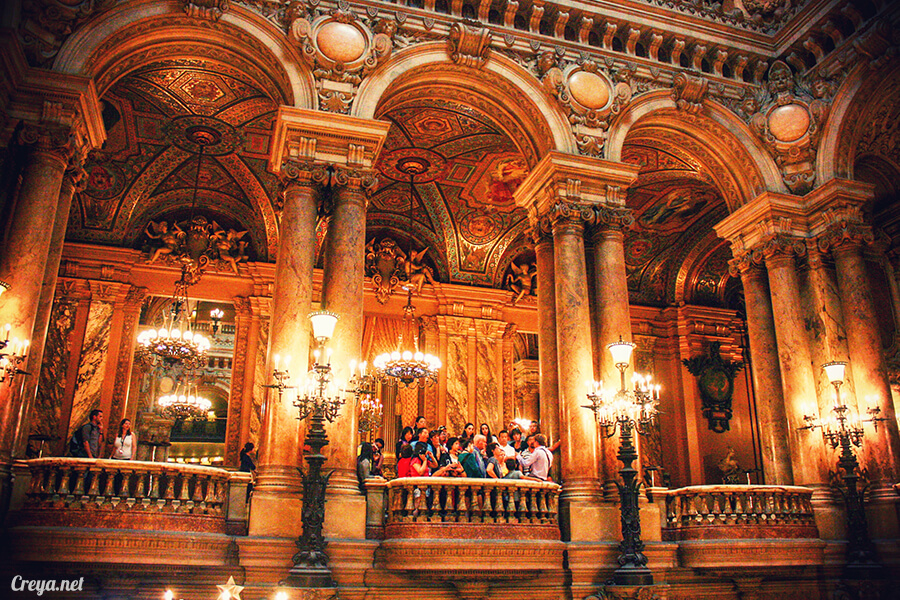
One trip to Paris taught me more than twelve years of history classes ever could (the fault lies with this humble student’s limited aptitude). In all sorts of situations, old sayings kept springing to mind for comparison, giving me a deeper appreciation of the vast and profound imagery of Chinese expression—and proving just how deeply rooted its cultural influence is in me (Taiwanese girl confirmed).
On Day 2 of my European legwork tour, the Palais Garnier proved the truth of an ancient saying: “Without first enduring the pain of finding no way there, how could one savor the antique charm of the Palais Garnier?” To see such a beautiful classical building, I first had to temper my will, strain my muscles, and circle the streets of Paris several times,thus ensuring that my European legwork tour truly lived up to its name!
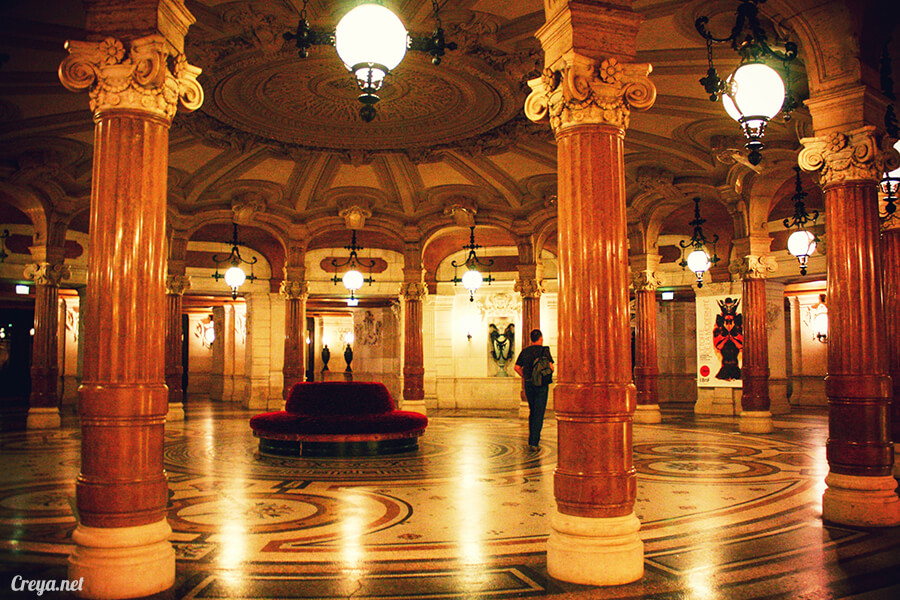
[ The moment I entered the Palais Garnier ticket hall, I felt its solemn, classical beauty—but why did it make me want to play hide-and-seek so badly…? (Be serious!) ]
It was my second day in Paris and the second morning of my 85-day journey around Europe. With no local friend to lead the way, my solo adventure was officially beginning. Exploring the streets of Paris alone for the first time, I was still rather timid and shy.I’m not naturally courageous. All I had was the foolish belief that stepping outside the door could change something, even if only a little. So I took a paper map with me, and my first goal was to walk from the Hostel to the Palais Garnier,only 20 minutes away.
I still loved the traditional way of navigating with a paper map. Every time I circled a destination, it felt like adding something to my wish list. Then I would bury myself in the map to understand how the entire area fit together before setting off with my treasure map and following its clues through the fog. Even though I already had an iPhone 4S, I still refused to give up my obsession with paper maps. Besides, I had heard aboutthe Parisian street magicians’ trick of making your phone vanish in a second—a performance guaranteed to haunt you forever. Everyone may look down on the 4S now, but back then it was cutting-edge, okay? (Hair flip.) So I only dared to tuck it carefully into a hidden pocket of my bag, terrified that the moment it saw daylight, it would die in someone else’s hands.
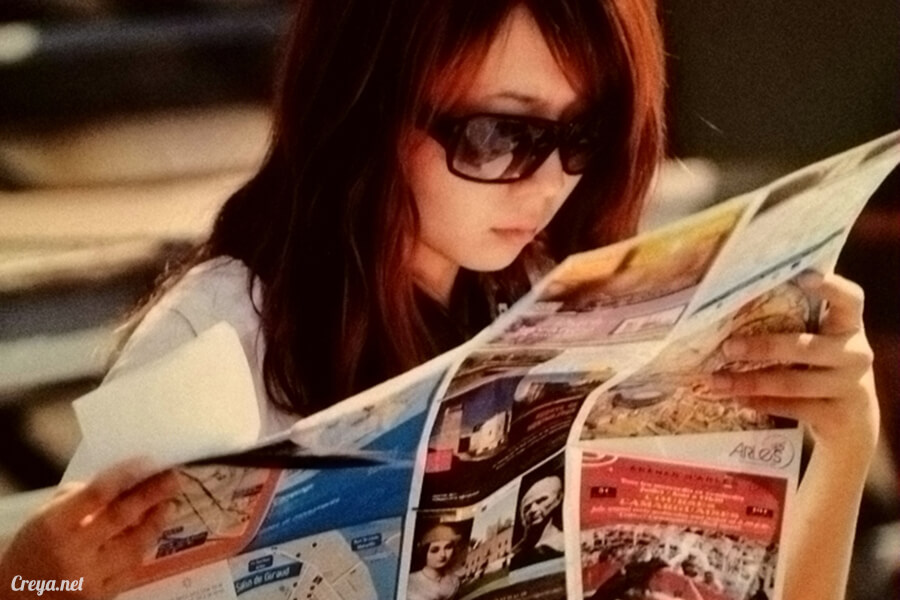
[ Besides, if you’re looking at a map, people know you’re a traveler. If you’re looking at your phone, they’ll only think you’re a Pokémon Master ]
At the time, I had no idea that a professionally hopeless navigator like me was about to face the ultimate slayer of the directionally challenged: “Paris.” And this paper-map equipment only gave me +1 defense…
The moment you accidentally wander into a Parisian side street, the road keeps splitting and multiplying into countless forks every few steps—and then those forks have forks of their own.Even my split ends had to admit defeatParis is full of magic. There wereso many branching streets that they couldn’t all fit onto the paper map in my hands(otherwise the map of Paris might have been as thick as the Oxford English Dictionary), and every French place name was both long and suspiciously similar. So if you carelessly took one wrong turn and strayed from the path, welcome to the Bermuda Triangle.
But even if you avoided the side streets, Paris was no pushover. Just when you seemed to be following a perfectly straight and correct road, your direction in life would suddenly acquire an inexplicable number of options: God gives you a roundabout, then thoughtfully adds six exits.

[ Do you really have to make a perfectly good road this complicated?! (Now I’m getting worked up.) ]
By the time I walked past the same Métro exit for the third time—and that damned station was right around the corner from the Hostel—I had somehow spent an entire hour making absolutely no progress within this tiny two-kilometer patch of Paris. At that point, I began admiring the logical wisdom behind ancient sayings.You would never hear anyone say, “All roads lead to Paris,” because the roads in Paris only lead you astray。
If getting lost is romantic….
then no wonder Paris is the City of Romance.
Unfortunately, I had not yet learned to enjoy such a romantic pace of travel at the time (it was a little too romantic).
After walking along the same street nine times, I finally risked my iPhone’s life and summoned Sister Google, Google Maps. I even mustered the courage to once again ask aFrench Q personFrench person for directions (thus experimentally proving that kind people do exist in France), and finally reached the entrance of the Palais Garnier. Even though I had arrived thinking I didn’t necessarily need to go inside, by then I was determined to spend money just to vent my frustration. (Could this entire thing have been a Parisian conspiracy?!)
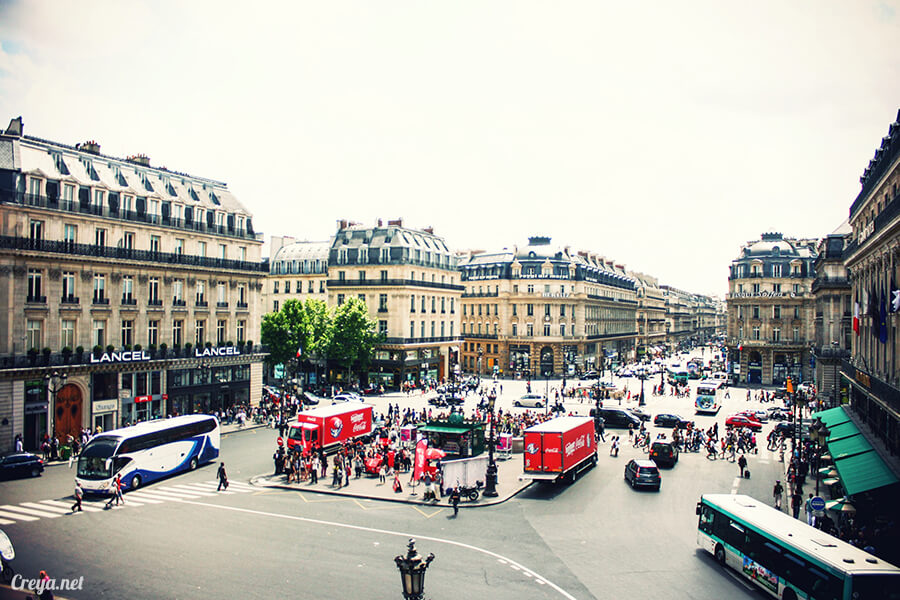
[ Avenue de l’Opéra in front of the Palais Garnier. Go on, count how many roads and side streets there are. (No prize for the correct answer.) ]
The Palais Garnier stands in central Paris, beside the famous Galeries Lafayette and Printemps department stores. You could call it prime luxury real estate. Sandwiched among all these magnificent French Beaux-Arts buildings,the Palais Garnier’s exterior and coloring do not look especially striking from a distance. I even passed it twice without realizing the opera house itself was right in front of me (so walking down the same street nine times was partly my own fault?!). But once I approached the building and looked up carefully, I noticed its understated extravagance. The finely detailed groups of statues on its façade introduced me to busts of musicians such as Beethoven and Mozart, the muses of poetry and harmony, Apollo presiding over the arts, and more—representing the many artistic disciplines embraced by the theater.
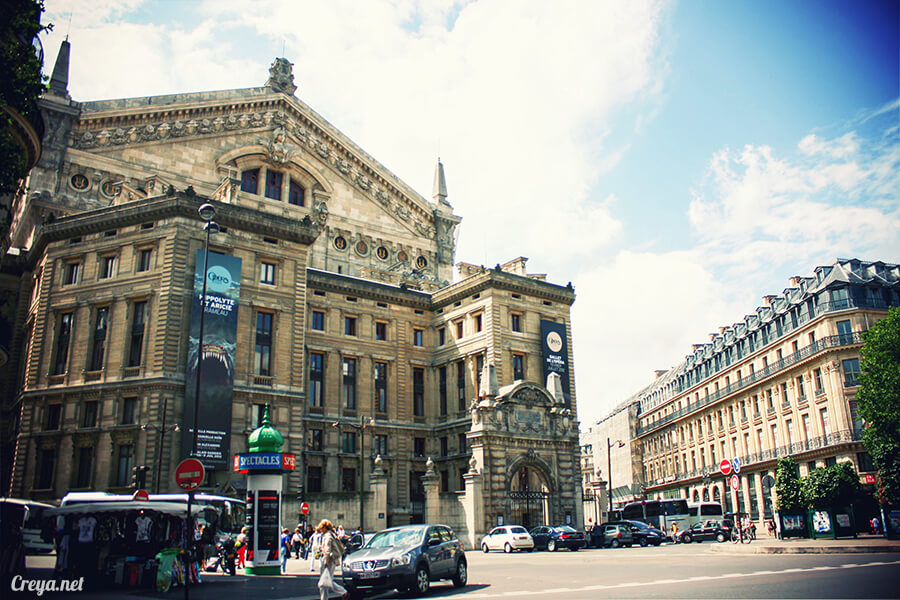
[ On the left isthe Palais Garnier.You have to admit it doesn’t look that different from the ostentatious mansion next door, right? (Bats eyelashes.) ]
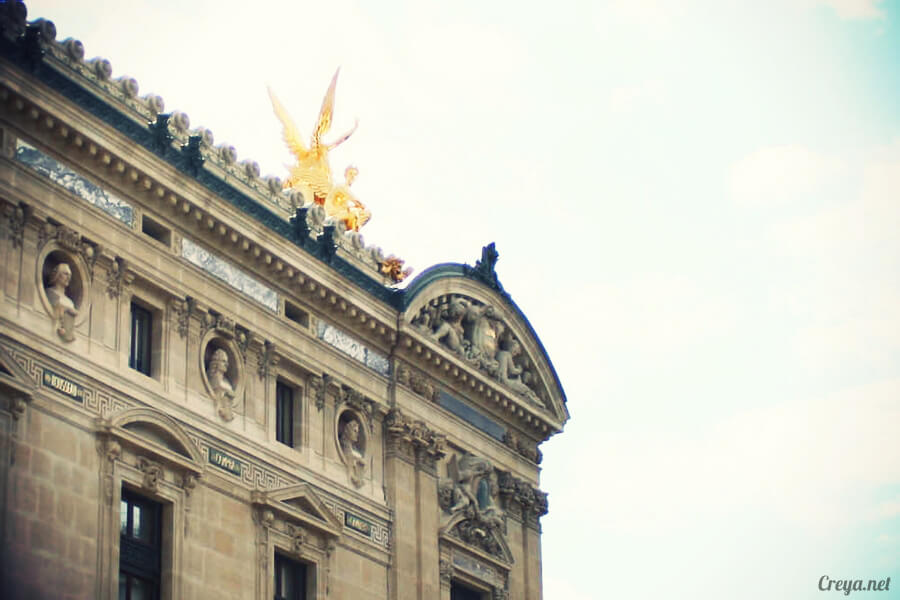
[ We have door gods; they have gods of the arts standing guard. ]
The Palais Garnier (also commonly called the Paris Opera; French: Opéra de Parisc / Opéra Garnier) still hosts many performances today, and you can buy tickets to attend a show. Orif you simply want to tour the theater, general admission is 11 euros, while visitors under 26 can enter with a discounted 7-euro ticket(information from August 2016).
Construction of the Palais Garnier began during Napoleon III’s reign in the mid-19th century. Its architect was, of course, Garnier. Previously unknown, he achieved lasting fame because of this opera house. It sounds like a classic rags-to-riches story, but he actually spentnearly 15 years building the theater. Originally commissioned for Napoleon III, the project endured war, funding shortages, the collapse of the imperial regime, and the rise of a new government before the seven-story opera house was finally completed.
Sadly, the tragedy of a new regime turning its back on the old is the same throughout history. Garnier reportedly even had to buy his own ticket to enter the theater for its opening (surely he at least deserved an employee discount). Because the building represented the feudal era of Napoleon III, it was unpopular with Parisians at the time, and someone even tried to assassinate him. He was quite the tragic figure of the century.
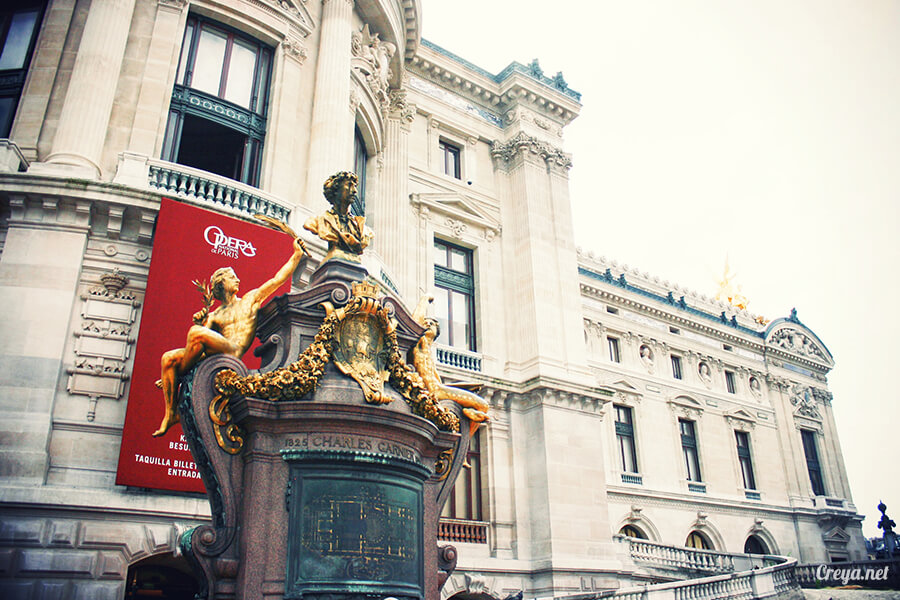
[ Even with his statue displayed in such a prominent spot, many people still don’t realize they’re looking right at Garnier. ]
Garnier blended Classical, Renaissance Revival, and Baroque architectural styles throughout the opera house. The result later became commonly known as the Second Empire style, orNapoleon III style. I thought thatafter visiting Versailles, one of France’s most lavish palaces, the previous day, nothing could shock me anymore. Yet I found myself completely captivated by the Palais Garnier’s modest exterior and solemn, magnificent interior.
I had found my favorite building in Paris!
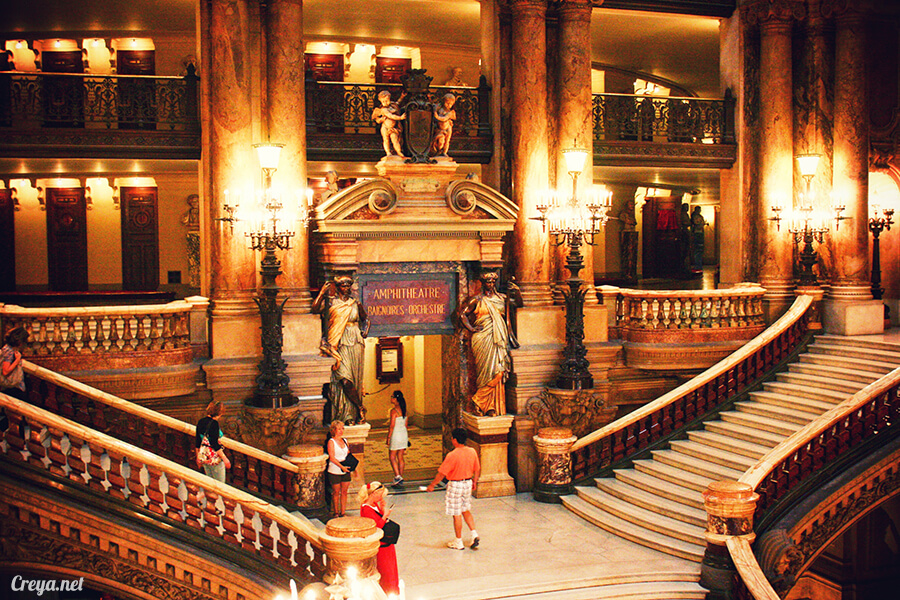
[ The Y-shaped staircase before me looked just like the grand ballroom foyer in a palace movie. It was pure girlish-fantasy heaven—I wanted to stay right there forever~ ]
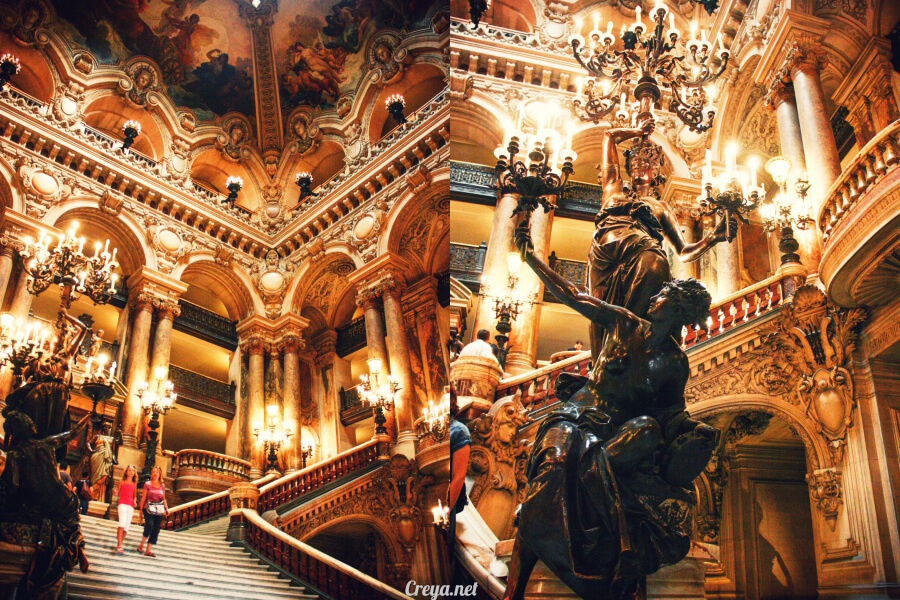
[ Every carving is incredibly intricate. Even the people walking down the stairs suddenly look majestic. ]
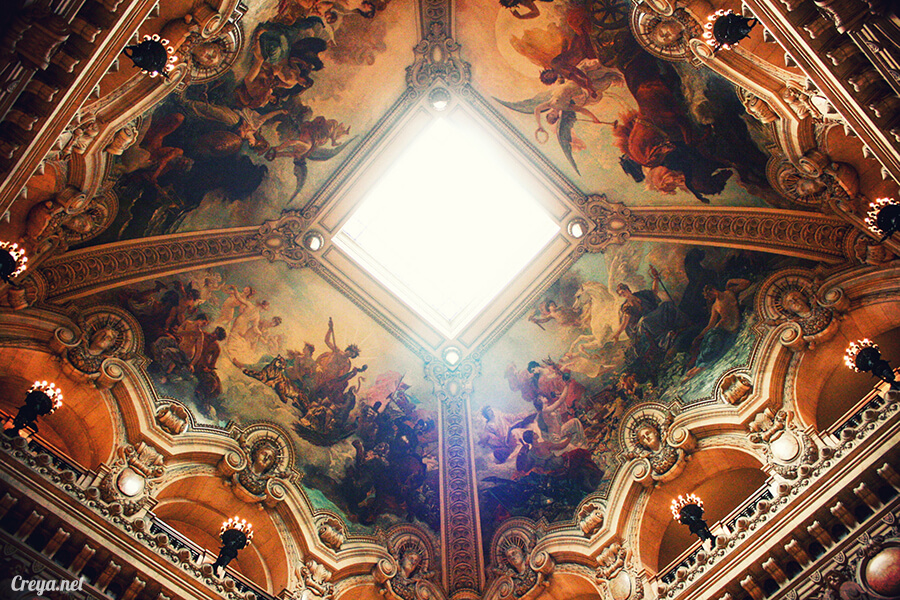
[ Stories from musical mythology are painted across the ceiling above the staircase. One trip around France will leave your neck very sore. ]
After touring the Palais Garnier, I became even more convinced that“intricate, confusing, and deliberately designed to keep people hopelessly trapped” is a deeply rooted Parisian tradition. The building alone has an astonishing 2,531 doors (where exactly are they all trying to take us?!). The mysterious power of the Palais Garnier even made itthe setting for The Phantom of the Opera。
[ I’ve bought tickets to both the film and the live musical of The Phantom of the Opera, so I qualify as a fan. The masquerade scene begins on the Y-shaped staircase. ]
The dark underground lake where the Phantom hides in the story is said to still exist beneath the opera house. During construction, workers accidentally struck groundwater while digging the foundations, flooding the basement. Garnier eventually used the water to fill gaps around the walls at the lowest level, strengthening the structure. As for the falling chandelier, during the first performance of the opera Thétis et Pélée in the late 19th century, an electrical fire caused it to fall and kill a middle-aged woman. These details all became important elements of The Phantom of the Opera. Whether embellished or not, they certainly fire the imagination.
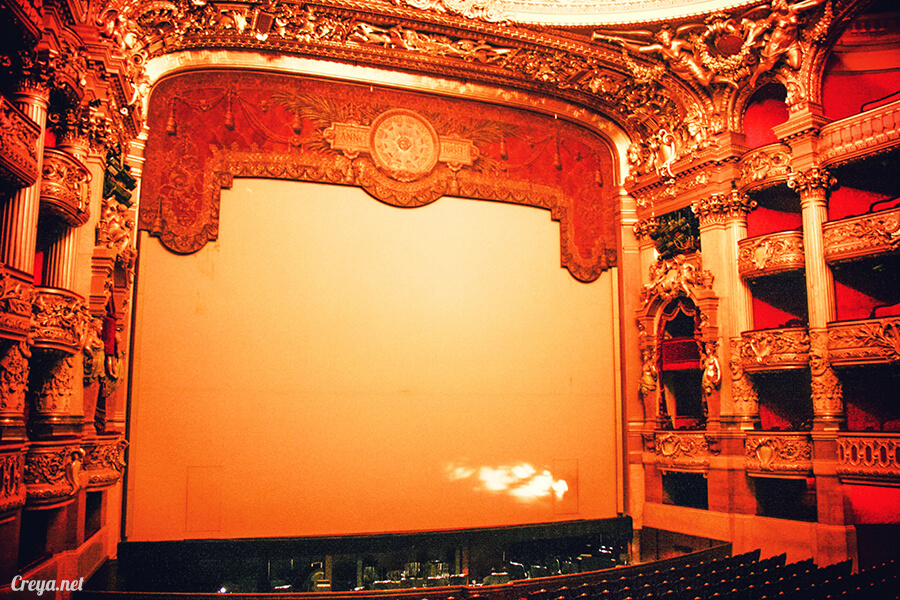
[ The main auditorium is unbelievably beautiful. Every carved detail is exquisite, and it would be well worth seeing a performance here. ]
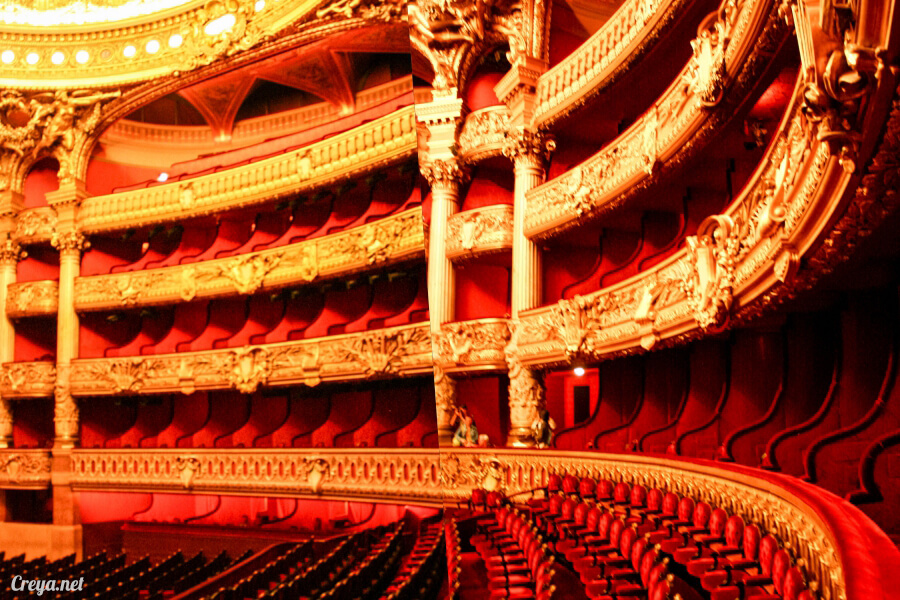
[ Aren’t the auditorium’s rows of ornate boxes the perfect real-life setting for aristocrats in billowing gowns, hiding giggles behind their fans? I had basically walked straight into a movie set. ]
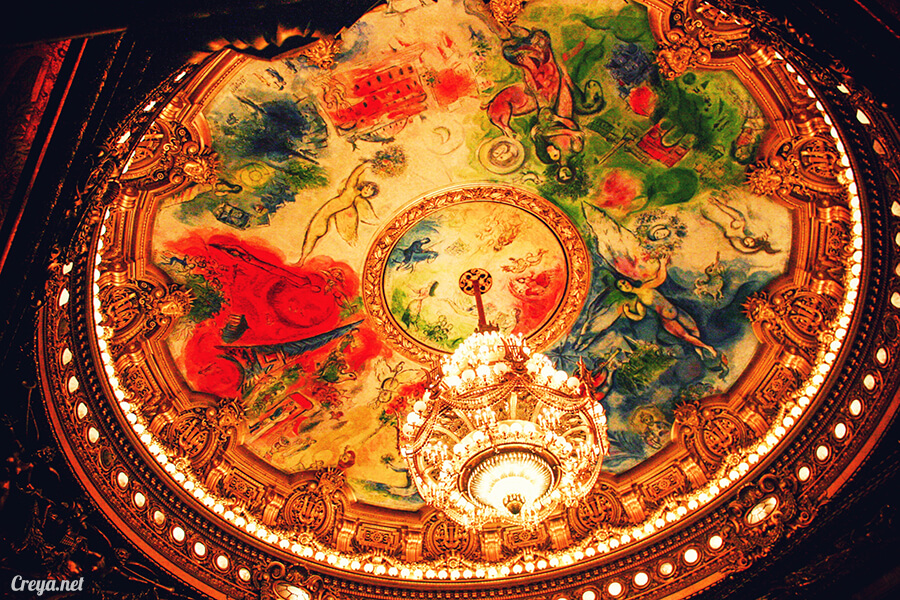
[ Chagall’s The Enchanted Bouquet on the auditorium ceiling, together with the iconic chandelier from The Phantom of the Opera. ]
[ Naturally, this is also where Christine makes her important stage appearance in The Phantom of the Opera. ]
I love the Palais Garnier’s elaborate, meticulously detailed carvings. Its antique-gold palette is restrained yet luxurious, while the patterned floors made from vast quantities of marble give the space a stately atmosphere. Everywhere you look, you can also find details designed with an understanding of physics and science.
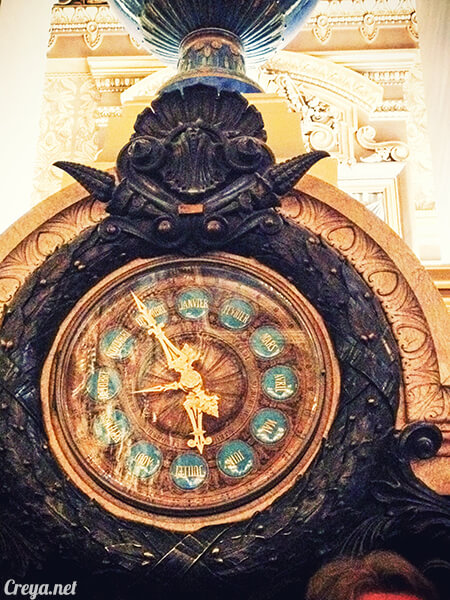
[ So this is another way to use a clock: a calendar clock showing the month and date. ]
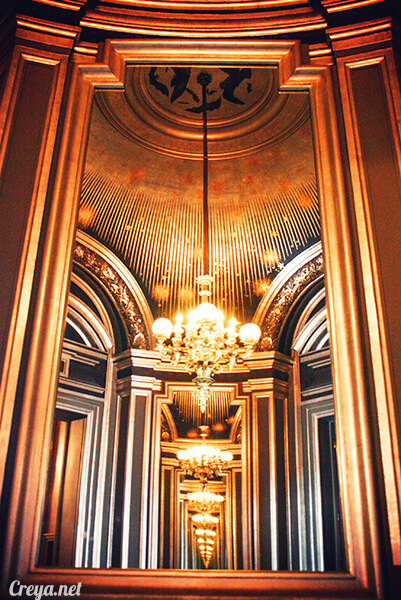
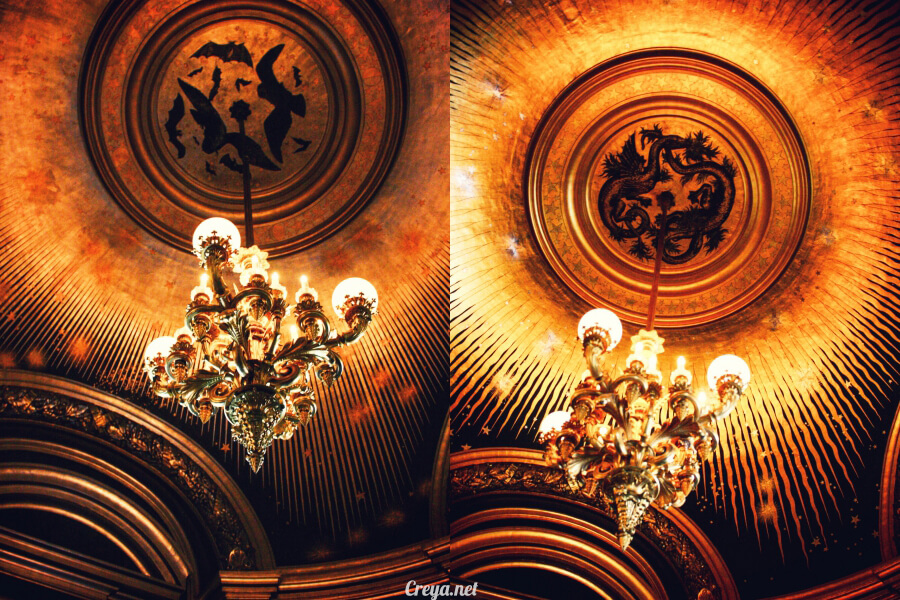
[ Covering everything under the sun is nothing unusual—the Palais Garnier includes the sun, moon, and stars too. On the left is the ceiling of the Moon Salon; on the right is the ceiling of the Sun Salon. ]
By comparison, Versailles, which I had visited the previous day, was like a nouveau riche tycoon terrified that nobody would notice his wealth and power. Every outrageously excessive decoration existed purely to emphasize luxury and riches, with a touch of brazen arrogance and absolutely no concern for whether visitors were being blinded by all the sparkle or suffering visual fatigue.To me, the Palais Garnier is a well-educated aristocratic lady: beautiful, distinguished, elegant, and understated, with a mind both delicate and complex. But her air of refinement simply cannot be concealed.
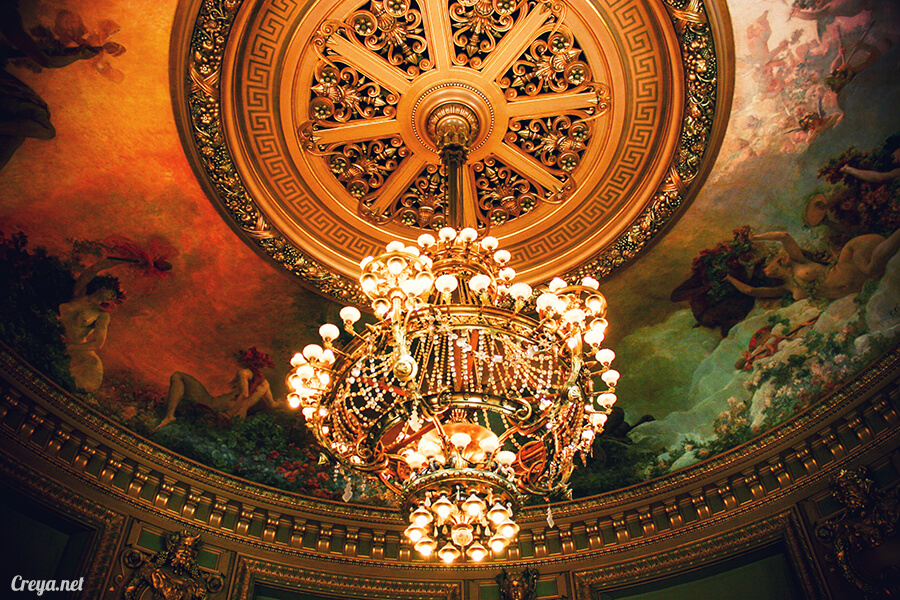
[ The Rotonde du Glacier. The Palais Garnier uses an enormous number of chandeliers. ]
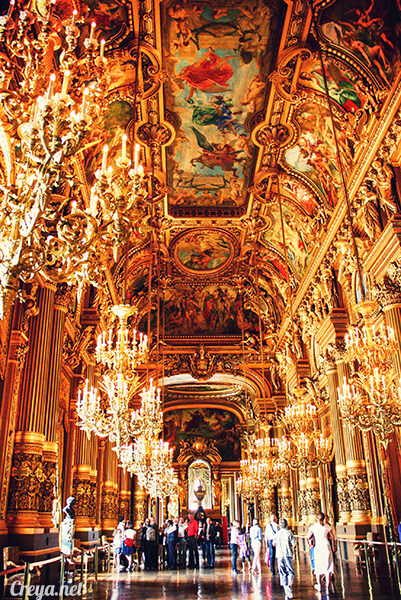
[ The Grand Foyer, where audience members can rest and socialize, is clearly issuing a direct challenge to the Hall of Mirrors at Versailles. Let the showdown begin! ]
But perhaps this aristocratic lady represents more than just Garnier.
Perhaps this is also what France is like,
dwelling within the soul of every French person.
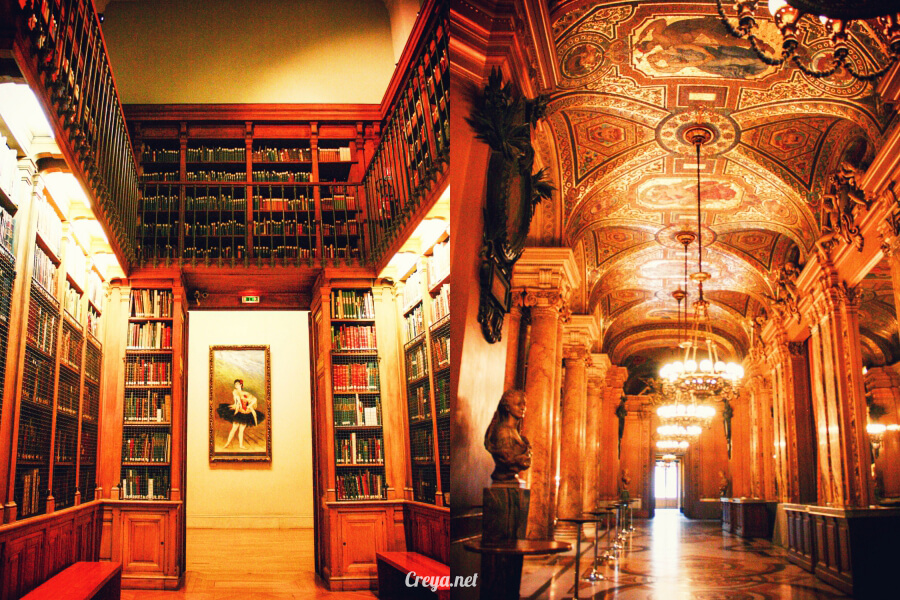 [ The library houses many books related to opera and the arts, along with stage-design models and more. ]
Admission
General admission: 11 euros
Students or visitors under 26: discounted ticket, 7 euros
Free for children under 10
Buy tickets on site orbuy tickets online
Visiting hours
Summer: 10am–5:30pm
All other times: 10am–4:30pm
Transportation information
Address
8 rues Scribe et Auber, 75009 Paris
Public transportation – Métro
Take Métro M3 / M7 / M8 to Opéra station, then walk about 3 minutes to the entrance
Public transportation – RER
Take RER Line A to Auber station, then walk about 2 minutes to the entrance
Official website
Paris Opera – Palais Garnier English website
✈ Travel date: 2012/6/30
| My European Legwork Tour | France in 9 Days series
● France: Not Quite What You Imagined?
● France Day 1 – What?! You Can’t Get By in English at Charles de Gaulle, France’s Biggest International Airport?
● France Day 1 – Versailles in Paris, France: Unblocking the Historical Connections in My Head
● France Day 2 – Without First Enduring the Pain of Finding No Way There, How Could One Savor the Antique Charm of Paris’s Palais Garnier?
● France Day 2 – The Historic Road Between the Arc de Triomphe and Champs-Élysées in Paris: Lamenting How Little I Know About History
● France Day 3 – The Louvre in Paris: That Faint Smile Hidden Away in a Golden House
● France Day 3 – My Impression of Paris! Impressionist Masterpieces at the Musée de l’Orangerie and Musée d’Orsay
● France Day 4 – Mont-Saint-Michel, France: So That’s Where the Hole in My Head Came From
● France Day 5 – Two Holy Sites in One Day: Seeing Two Sides of Parisians at Sacré-Cœur and Notre-Dame
● France Days 1–5 – The Eiffel Tower: Five Views of This Magical Lighthouse in Paris, France
● France Day 6 – Avignon, an Ancient City in Provence Even More Beautiful at Sunset
● France Day 7 – Taking One Dashing Stroll Through the Lavender Fields and Red Towns of Provence
● France Day 8 – Arles in Southern France: The Ancient Roman Empire Through My Eyes and Van Gogh’s Brush
● France Day 8 – Another Ancient Roman Town in Southern France: How Well Do Old and New Mix in Nimes?
● France Day 9 – That Year, I Became Part of the Festival d’Avignon in Southern France….
| My European Legwork Tour | 85 Days Around Europe, 16 CountriesFull list of more articles


