


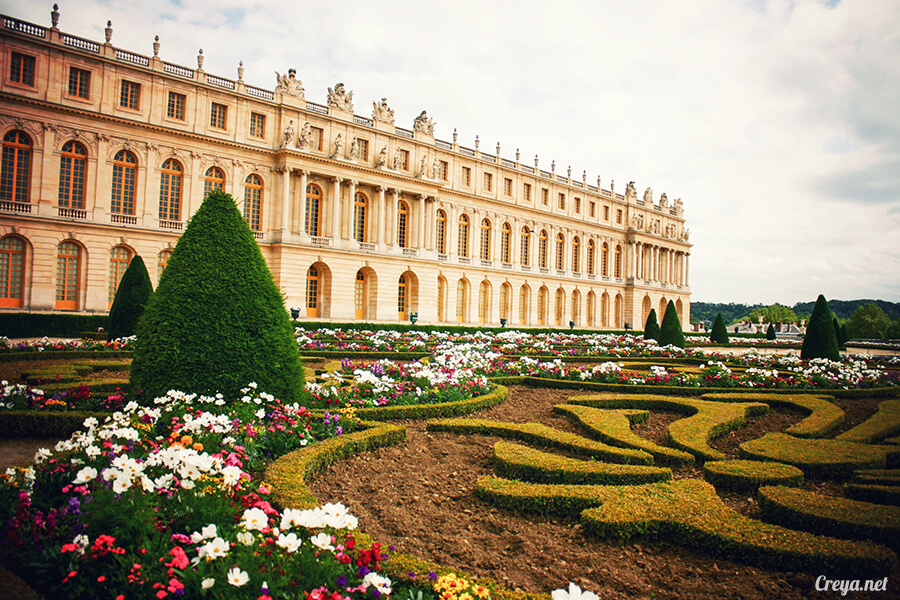
I boarded a flying piece of iron, thinking it was Aladdin’s magic carpet carrying me 9.8 million metres from Taiwan to Paris. Little did I know it was actually Doraemon’s time machine, thrusting me into a tunnel leading three hundred years into the past. Was the Paris beneath my feet the 21st century’sfried chicken… oops, wrong order— French Fries, or the sky of the 17th century? Or do parallel universes truly exist, allowing the past to illuminate the present, the present to carry history forward, and every moment to display the ancient and modern at once?
 [ A single thread connecting the Bourbon dynasty’s family history all the way to the present. (My actual inner monologue at the time was: Who on earth are these people?) ]
The Palace of Versailles (Le château de Versailles) lies just outside central Paris.Take RER C to the final stop, Versailles Château Rive Gauche, then put your Europe-walking legs to work for 10 minutes; alternatively, get off at Versailles–Chantiers and walk for another 15–20 minutes(Line C has several branches, so make sure you board the right one). Don’t worry about getting lost in unfamiliar territory—just pick a lead sheep and follow the crowd. The magnificent Palace of Versailles will soon appear before you, and the ticket for travelling through timecosts a modest €18(the full Passport ticket covering every area; it was three euros cheaper in 2012).
[ The airport express into the city is actually quite old, and someone had even tried to leave their name in the annals of
We were so engrossed in catching up that we almost forgot where we were—until an unbearably dazzling glare stabbed us in the eyes. Only then did we realise that an outrageously ornate palace straight out of a film had appeared directly ahead.
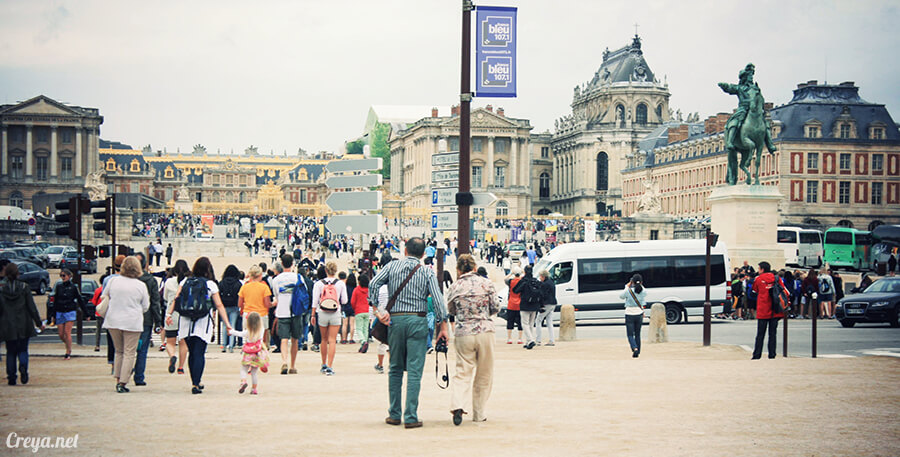 [ You really can’t get lost here in summer. Walk towards the crowds or towards whatever is sparkling—you can’t go wrong! ]
Even from a considerable distance, before the entire building had come into view, the sheer expanse of the grounds was enough to stun a city bumpkin (me) who had never seen such an enormous palace. The impact rivalled seeing Australia’s Uluru rise above the horizon all those years ago.For one instant, their existence felt completely unreal. In the next, I began to suspect that the time and space I was occupying right then were fake too!
 [ Beyond the vast, level square, the magnificent Palace of Versailles sprawls across an astonishing area, practically shouting, “That’s right, I’m fabulous.” Truly legendary. ]
In the early 17th century, Versailles was merely Louis XIII’s hunting lodge, set amid forests and marshes. Then, during the reign of Louis XIV in the mid-17th century, he visited the château of his finance minister, Fouquet, one day and discovered that none of his own homes could compare. Humiliated and furious, Louis XIV slapped Fouquet with corruption charges and threw him in prison, then poached the designers of Fouquet’s château to create a new royal residence. Using Louis XIII’s hunting lodge as its foundation, the palace we see today finally emerged after more than forty years of design and construction, receiving a major upgrade into a new royal palace. (The moral of the story: never casually invite a petty man over to your house.) (The wilful games only rich people can afford.)
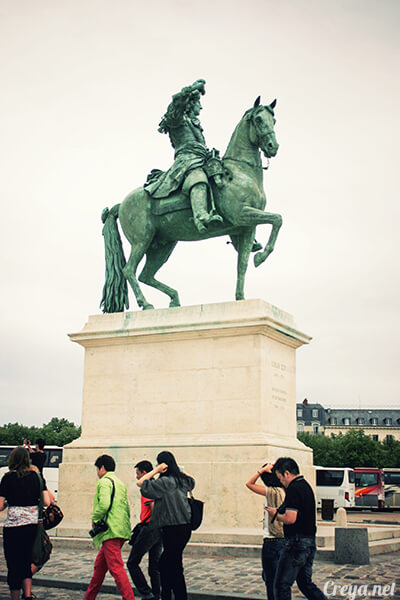
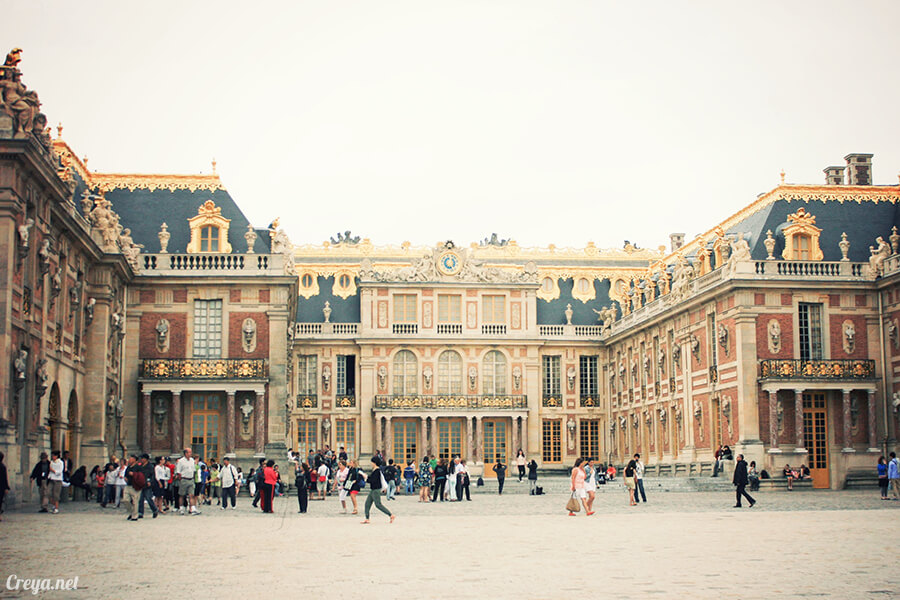
Versailles was my first attraction in Europe and the first European palace I had ever seen. Before this, I truly had never encountered interior décor like it. Ornately carved columns and beams surrounded every room; furniture and fabrics were smothered in intricate patterns; look up, and classical oil paintings covered the ceilings from edge to edge, glorifying Louis XIV’s great achievements and military victories. Then there were the unmistakably luxurious marble finishes, topped off with liberal splashes of “nouveau-riche gold” everywhere.There seemed to be no genuine blank space anywhere in the room.。
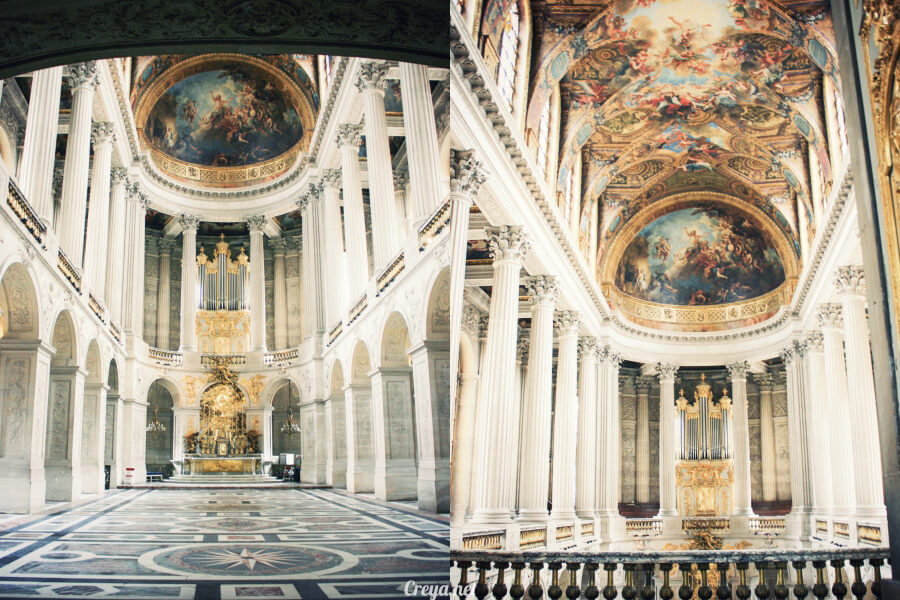
[ The Royal Chapel, whose dome depicts the story of Christ’s resurrection. ]
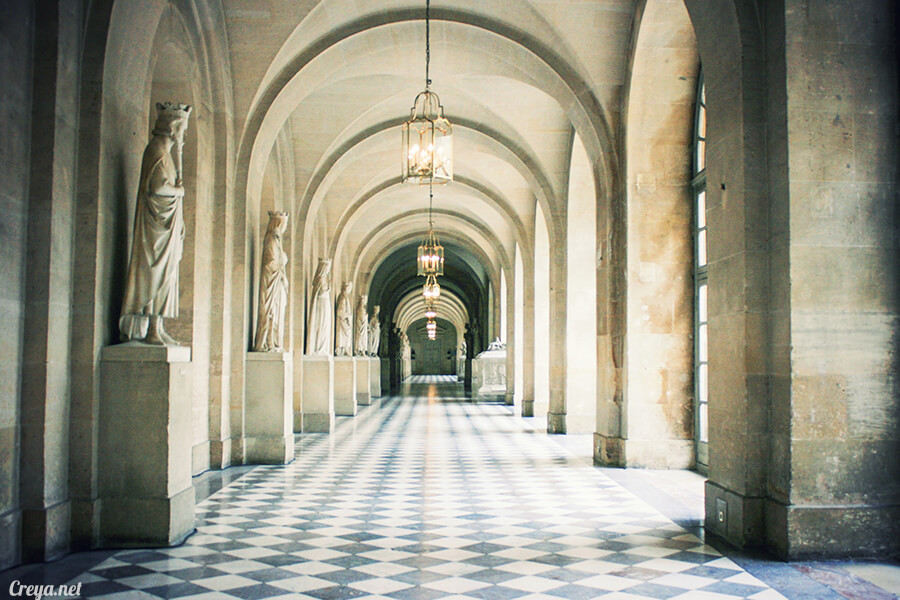
[ Walk down the long corridors with their classically symmetrical black-and-white chequered floors, while statues on both sides keep staring at you, and you can’t help feeling a sudden sense of awe. (It’s Ghost Month, you know.) ]
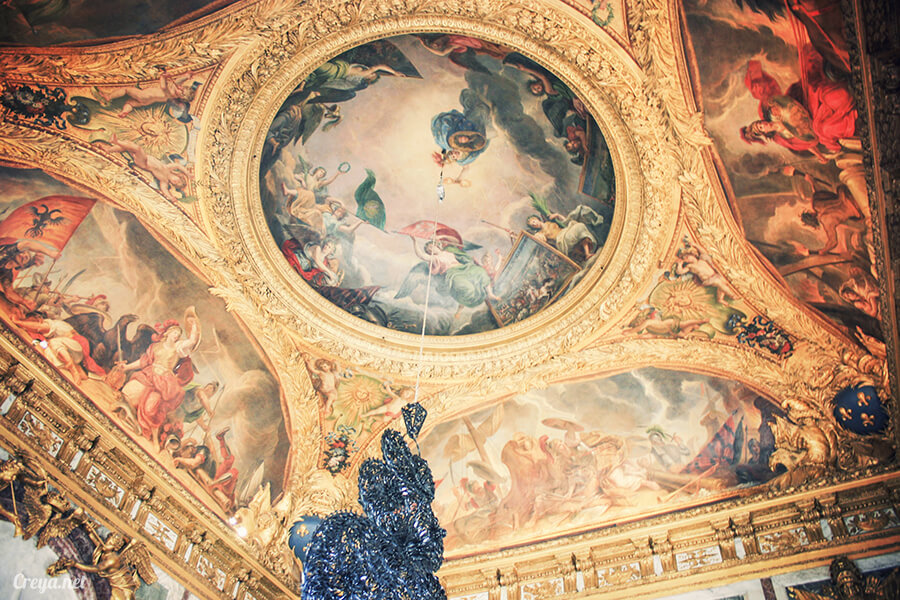
[ Every ceiling has a different oil painting—it’s like living inside an art museum. ]
At this point, Mr Audio Guide whispered the secret password into my ear: “Baroque style.” It was a term that had vanished from my life the moment I finished my secondary-school exams. My head felt as if it had been struck hard, and suddenly everything made sense. At last, I understood what “overly elaborate and excessively ornate” truly meant—and I was definitely never going to forget it again!All those technical terms I could never untangle, the dates and names I forgot as soon as I memorised them, and the historical stories that seemed to have nothing to do with me suddenly sprouted Avatar-like tendrils and connected themselves to me.
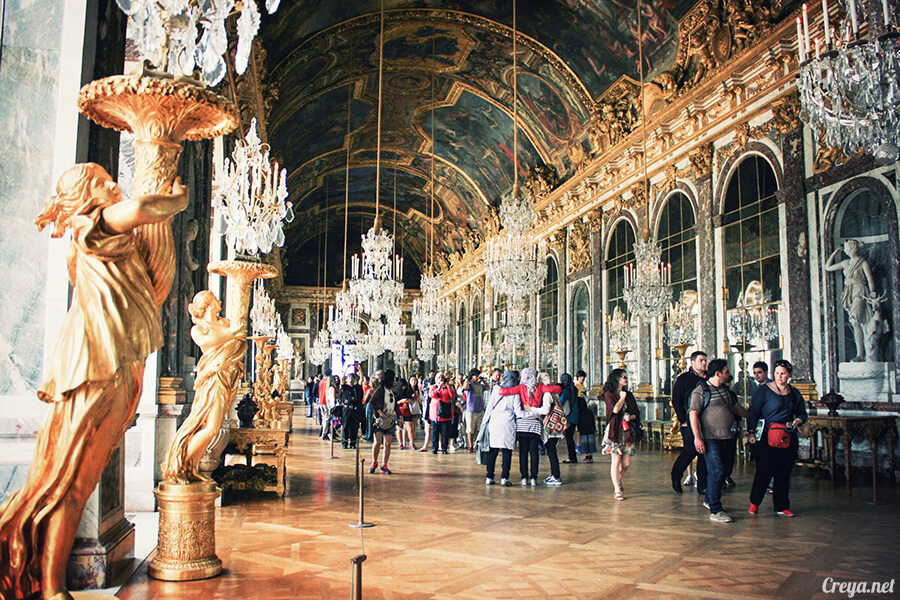
[ The Hall of Mirrors (Galerie des Glaces), the most famous room in Versailles, was used for balls and receiving diplomatic envoys. ]
[ Walking through this living history in person, you can take a history lesson through an audio guide or a tour guide. (This photo perfectly captures the four states of visitors inside Versailles.) ]
I noticed several large decorations in the galleries that looked wildly out of place in Louis’s era. At first, I assumed France was doing the same thing as Taiwan—putting a few chibi figurines in a historic monument and calling it “cultural creativity.” But when I approached and read the information panel, I discovered that I was lucky enough to catch Portuguese artist Joana Vasconcelos’s 2012 contemporary-art exhibition, which expressed her feminist ideas inside Versailles.
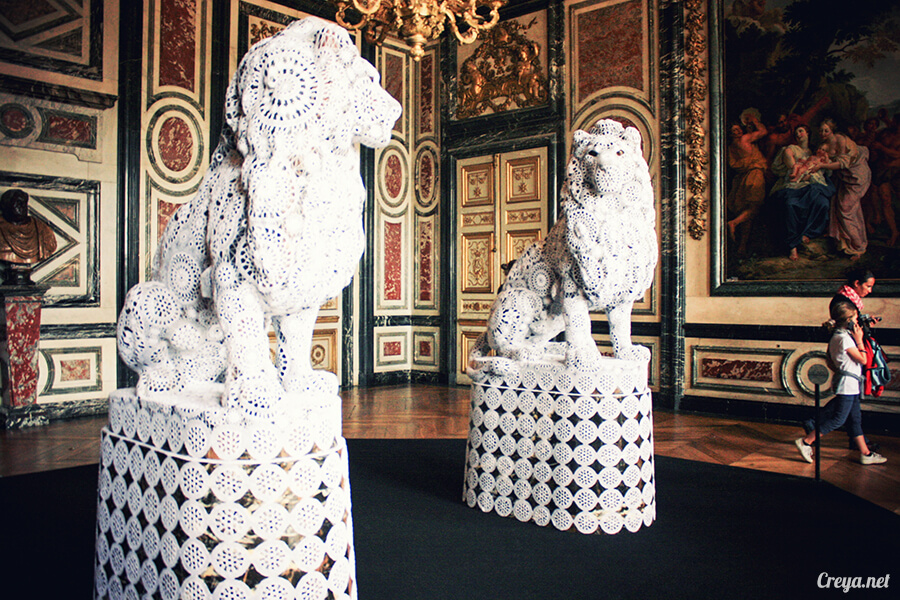
[ This lace-covered stone lion was the work whose feminist concept I could grasp most clearly. Its ornate lace pattern also blended naturally into the atmosphere of Versailles. ]
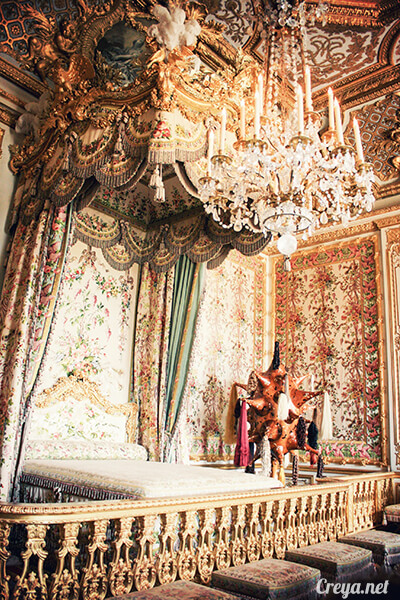
[ Something resembling the meridian-massage gadgets sold at Taiwanese night markets had also sprouted inside the bedchamber of French queen Marie Antoinette. ]
Since 2008, Versailles has spent several months each year pairing this historic building with contemporary-art exhibitions. Pop artists and Japanese artist Takashi Murakami have all been invited to create installations here, sparking conversation after conversation between contemporary and classical art—and argument after argument between supporters of the contemporary and conservative critics.The subjective lineage of art continues to this day, and it remains a debate with no right or wrong answer.。
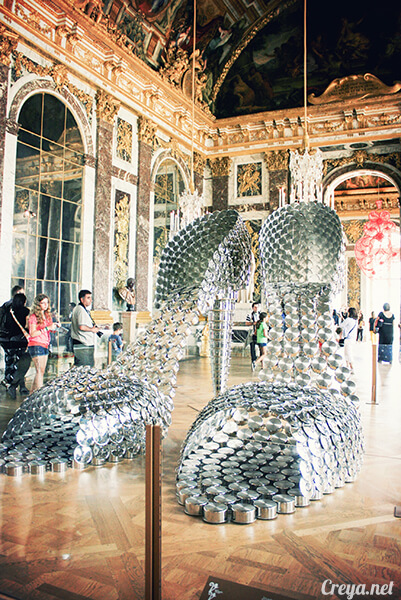
[ This conspicuous work in the Hall of Mirrors echoesthe hall itself, using reflectivepots arranged into high heels to represent women’s dual roles inside and outside the home. ]
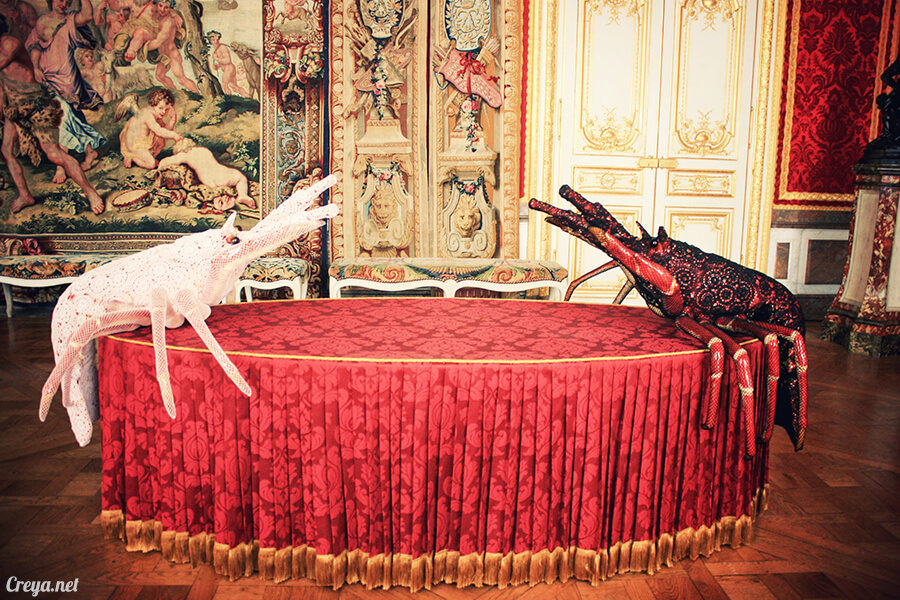
[ Shrimp and super shrimp: classical art you can’t understand or contemporary art you can’t understand—which do you choose? ]
Before entering Versailles, I assumed it would be like visiting the Presidential Office Building or an old traditional courtyard house: a quick look at the European old-school versions of bedrooms, dining rooms, and reception halls, perhaps with some tableware, collectibles, and carved decorations on display. As it turned out, none of thosestandard attractions were missing—but the scale also came with the weight of an art museum, a history museum, and ten volumes of historical records.。
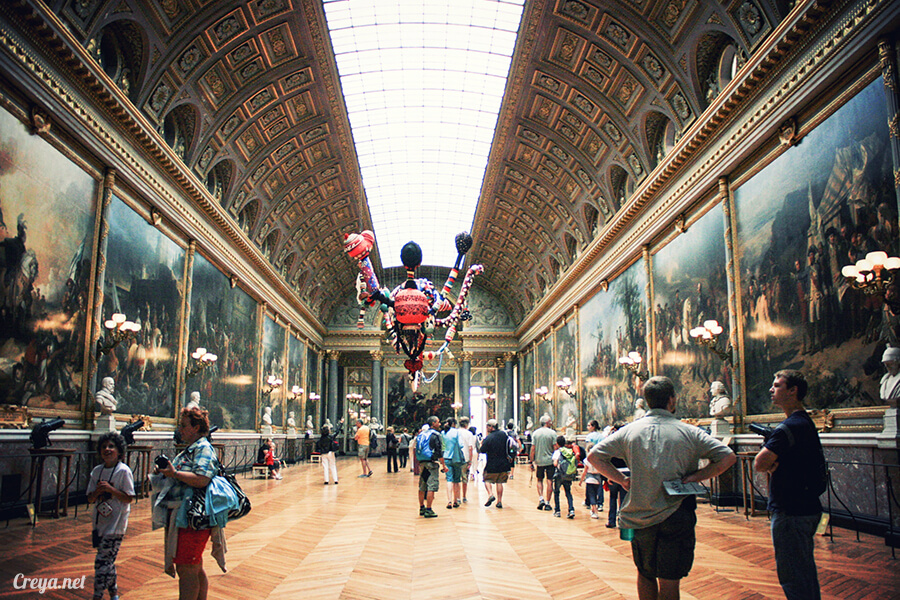
[ The paintings of military campaigns lining the gallery left a deep impression on me. Versailles is more than a former residence; it is also a history museum and an art museum. ]
Butthe palace itself is also a leading character in French history. It symbolises the establishment of Louis XIV’s absolute monarchy, witnessed the collapse of the monarchy during the French Revolution, hosted the signing of the peace treaty that ended World War I yet helped set the fuse for World War II, and continues to serve as a venue for international conferences and treaty signings by the modern French government.
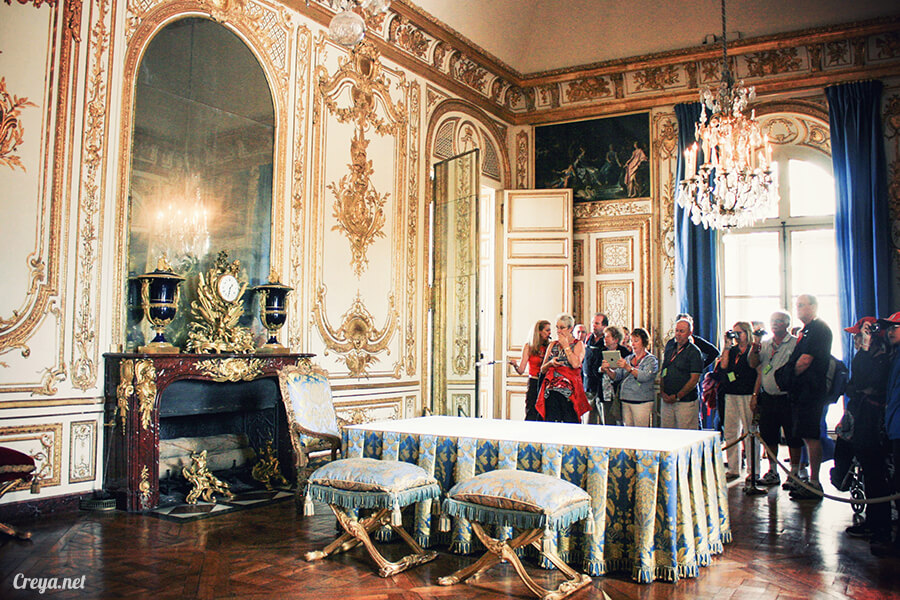
It rose from a hunting lodge into a royal court, then fell into decline and was looted. Today, visitors from around the world pour in every day simply to glimpse this World Heritage Site saturated with the marks of history.It is like a seasoned elder, using its very existence to tell the world its life story and warn later generations not to repeat the same mistakes—even if not everyone is willing to listen. It represents the France of the past, and the France of today.
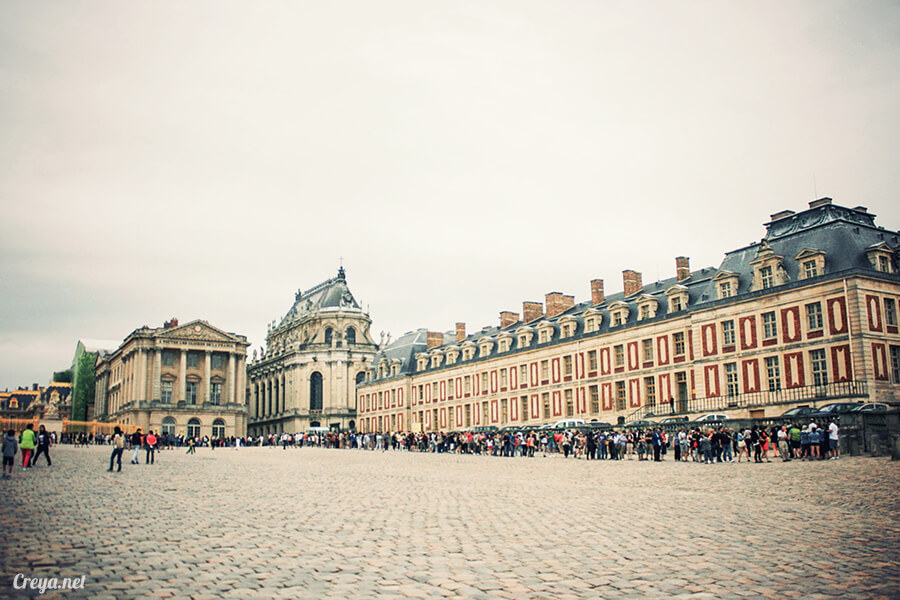
[ There were enough people queuing to enter to measure the full length of both wings. ]
That history continues to shape the present, just as our homeland remains tied to who we are—whether we are talking about France or myself.
 [ The clearest example of history reflected in me is… how could I possibly have looked so young back then! I’m getting old—give me back my youth~ ]
After an hour and a half of travelling through time, I finally emerged from this enormous building laden with far too many stories, and my excitement at last began to settle. (Although I was still inside Versailles, in its absurdly enormous gardens covering millions of square metres.) It brought me back from three hundred years ago to the present. During those last few hours—or rather, during the 24 hours since leaving Taiwan—I felt as though I had been dragged sideways across the Earth into another dimension.
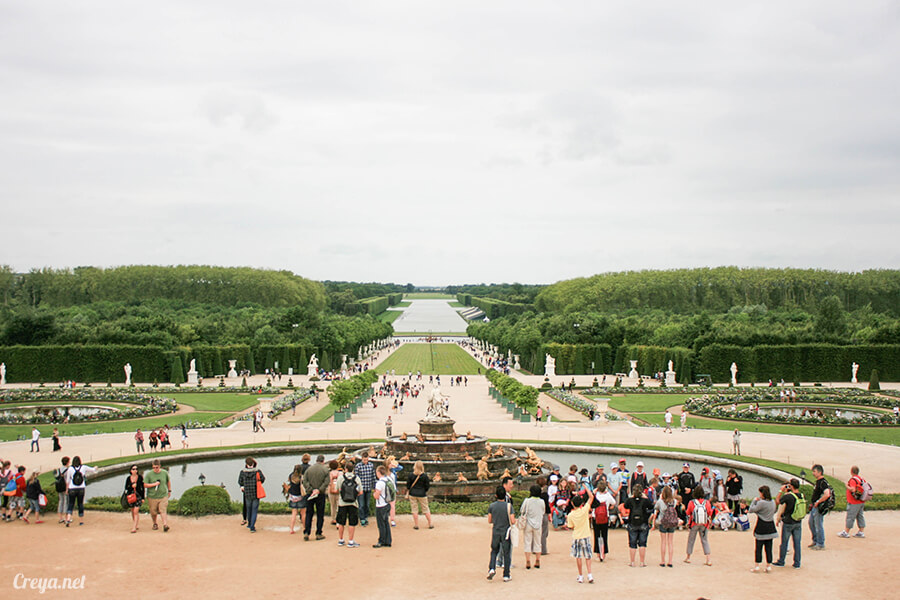
[ The gardens can be visited without a ticket and are filled with exquisite statues. They are so vast that people used to tour them on horseback. ]
Paris public transport journey planner >>vianavigo website
In 2012, a day pass could cover both the airport and Versailles despite the distance between them. Today’s day passes do not include the airport. (Back then, a one-day Zone 1–6 pass cost €20.5.)
Today, I recommend buying a one-way ticket from the airport into the city, then purchasing a return ticket to Versailles separately.
(Information from August 2016)
Ticket prices:All-inclusive Passport ticket €18; two-day Passport €25
Palace-only ticket €15
Opening hours: see theofficial Chinese-language website
Address: Place d’Armes – 78000 Versailles
✈ Travel date: 2012/6/29
| Watch Me Walk Europe | France in 9 Days Series
● France: Not What You Expected?
● France Day 1 – What! You Can’t Get By in English at Charles de Gaulle, France’s Biggest International Airport?
● France Day 1 – The Palace of Versailles in Paris: Unblocking the Historical Connections in My Brain
● France Day 2 – Only After Getting Thoroughly Lost Can You Savour the Antique Charm of the Palais Garnier in Paris
● France Day 2 – The Historic Road Between Paris’s Arc de Triomphe and Champs-Élysées, and My Lamentable Ignorance of History
● France Day 3 – The Louvre in Paris: That Faint Smile Hidden Away in a Gilded Palace
● France Day 3 – My Own Impression of Paris! Impressionist Masterpieces at the Musée de l’Orangerie and Musée d’Orsay
● France Day 4 – Mont-Saint-Michel, France: So That’s Where the Hole in My Head Came From
● France Day 5 – Two Holy Sites in One Paris Day: Two Sides of Paris at Sacré-Cœur and Notre-Dame
● France Days 1–5 – The Eiffel Tower: Five Views of Paris’s Magic Lamp Tower
● France Day 6 – Avignon, the Ancient Provençal City Even More Beautiful at Sunset
● France Day 7 – Living It Up in the Lavender Fields and Red Towns of Provence
● France Day 8 – Arles in Southern France: The Ancient Roman Empire Through My Eyes and Van Gogh’s Brush
● France Day 8 – Another Ancient Roman Town in Southern France: How Well Do Old and New Mix in Nîmes?
● France Day 9 – That Year, I Became Part of the Festival d’Avignon in Southern France….
| Watch Me Walk Europe | 85 Days Around Europe, 16 CountriesComplete List of More Articles


