


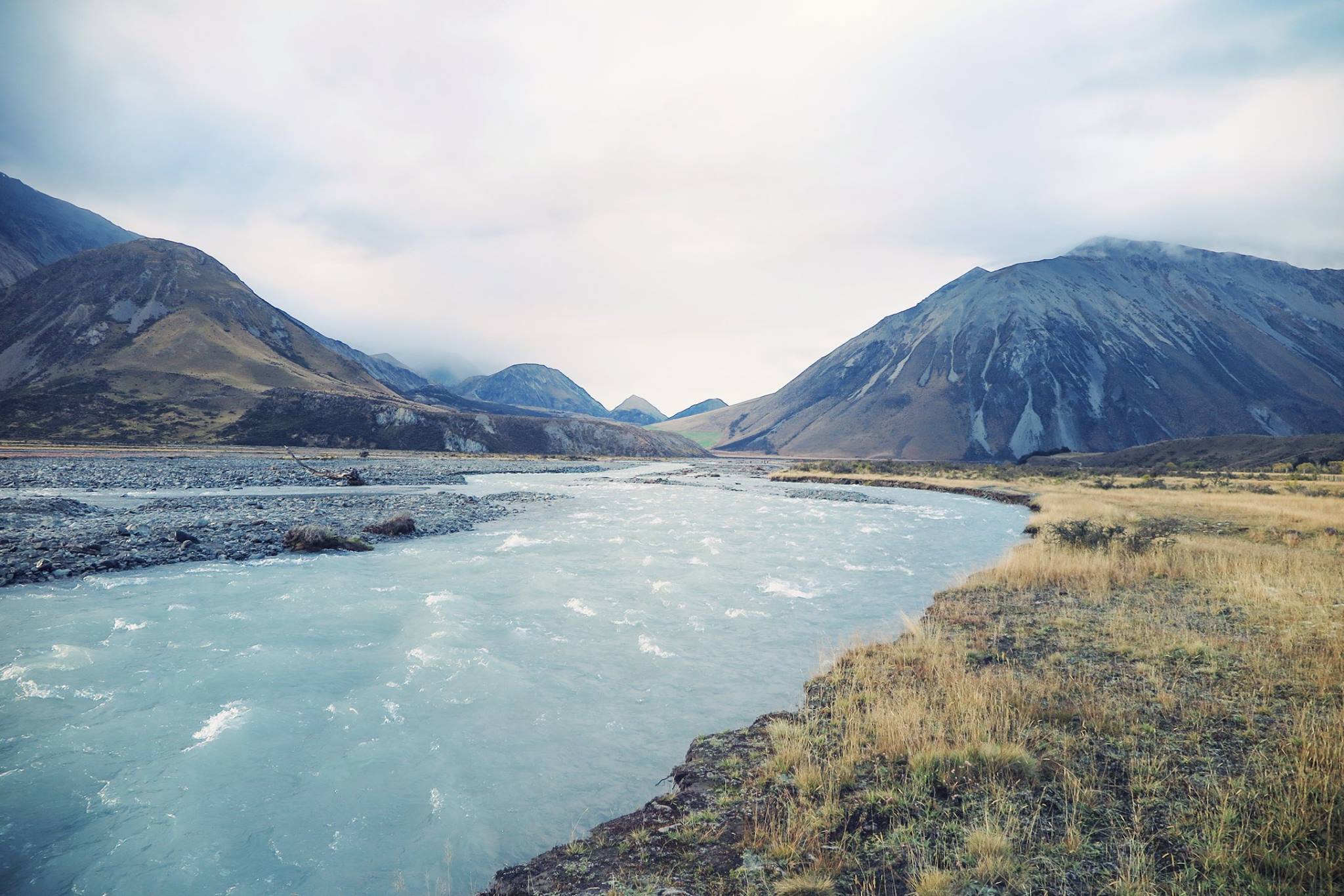
Reaching the 2,200-kilometer mark of Te Araroa Trail (approximately 3,000 kilometers in total), and it’s the 90th day of walking the trail.
Rare twin storms battered New Zealand in April, right in the middle of autumn—a sight typically seen only in tropical Australia, or so the radio broadcasts claimed, and it wasn’t just one local resident who told me: “The weather this year is really unusually strange.”
Yet what did those keywords—’rare,’ ‘storm,’ ‘unusual’—mean to me? Especially on my first time visiting New Zealand, I had no past experience to build any sense of what it should look like. Only the intermittent downpour outside the window, pitter-pattering relentlessly, felt real. Only the grey, lightless sky overhead, foretelling the challenges ahead, was tangible.
This 63-kilometer mountain section begins at a fast-flowing river, and along the way I’d have to ford streams dozens of times. The trail documentation for this section clearly stated, in bold: ‘Do not attempt to cross the river after heavy rain.’ Having taken a week off from the trail to play on the west coast and avoid the bad weather, it seemed I couldn’t escape nature’s unkindness after all. As late autumn faded and early winter approached, time was running out, and I felt I couldn’t afford to waste a single day.
But how to face an impassable river?
Walking southward from the north, I thought about the other side of the 63-kilometer section. Looking at the map, that side also required crossing a river to reach the mountain trail, but reading through the trail documentation carefully, I found no warnings. Searching through other hikers’ experiences, nothing seemed difficult. Maybe it wasn’t a big river? Maybe there was a bridge? I figured reversing direction and hiking this section from south to north might be the answer. The southern trailhead required passing through some road scenery before connecting to the river crossing, so that would cost me a day, but at least I’d keep moving forward, which felt more fulfilling. Deep down, I hoped the river would recede as time passed.
So I hitched rides and pursued the most viable plan, making my way through five rides and a night of camping, and successfully reached the southern trailhead. It was during this long journey that I learned the news about the twin storms approaching. Yet the next day brought light rain and then clear skies, and I secretly transformed the locals’ uncertain warnings into extreme optimism. Walking along the road with hopeful steps, well, at least it was better than standing still, right? I was still moving forward! That’s what I told myself.
Entering a small settlement, I heard the sound of rushing water cascading down—probably just a small spillway, I thought. How wrong I was. Instead I saw a creek overflowing with fast-moving, murky water. My heart sank along with the ambient temperature—it was 40 degrees latitude in autumn. The actual river crossing was still over an hour away, but this creek beside the settlement seemed to foreshadow everything. My prayers and optimism crashed headlong into reality. At the campsite, I pitched my tent and stayed for three nights. Heavy rain pelted my small, elegant geodesic tent without mercy, each droplet echoing with heartbreak inside the shelter. Night after night I counted my remaining food, calculating how much longer I could hold on, and when I should retreat.
The rain gradually lightened. On the morning of the fourth day, warmth I hadn’t felt in days woke me. I clearly remember the emotion when sunlight touched my skin—it gave me courage, urging me to leave the tent and finally face the river crossing I’d been dreading. Hope returned, and I headed toward the river. Over an hour later, I reached it and understood something: not everything unfolds the way you hope, no matter how hard you push toward it. You must face the fact that sometimes you’re simply powerless.
It was a broad stream formed by countless tributaries, its expanse stretching beyond what my eyes could see or my mind could imagine. The water before me rushed frantically in a roar. My thoughts tumbled like that milky water itself, churning. Under the sunlight it displayed a beautiful milk-blue color. If I only wanted to admire it from a distance, it was gorgeous, truly gorgeous. But to actually cross it? Impossible to gauge its depth, and crossing might be fatal.
I had one last day of rations to work with. I set my pack down in an open area away from the riverbank and gambled on one more night of waiting. Again, disappointment. The water receded slowly, but not fast enough to match the pace of my dwindling food. Standing before the river and gazing at the distant far bank, I couldn’t even see beyond my line of sight to know if more tributaries were rushing past. One hour, two hours, several hours. I picked up my pack, smiled at it, turned away, and took a step, then another, retracing my path back to the road.
Avoca River, this time I couldn’t cross your expanse, nor could I experience the Goat Pass trail beyond you. I tried my best to reach you, but I didn’t want to hurt myself. The mountain will always be there. There is no path that must be walked, no summit that must be reached—only attachments we can let go of, and a self that doesn’t regret.
———–
If it were you, what decision would you make?
(Reflection on April 16, 2017 journal entry)
📍 Te Araroa Trail | New Zealand 3,000-Kilometer Hiking Journal| Return to Complete Series Index


