


I rarely tell people about this. Maybe I simply do not want my mind to keep replaying those scenes. More than a year has passed, yet whenever I think about the experience, my body still trembles involuntarily and my chest feels clenched. I need several deep breaths before I can slowly settle down from the fear.
(This story is a little long, and much longer inside my head. If you are ready, I invite you to read it.)
This happened when I was still walking across New Zealand’s North Island. I estimated that I would reach the southern tip of the island in another two weeks, just in time to welcome my university friends for a road trip.
Everything seemed to be going according to plan. I was full of anticipation.
It rained all night. Listening to the rain outside my tent, I worried several times that I would not sleep well, because the map ahead showed several streams crossing the trail, and I would have to wade through them.
I was camping with two American women, but it was not where we had originally planned to stop, and there should not have been only three of us. The six of us had different paces, so the plan to finish most of the stream crossings before the rain fell had fallen badly behind. In the end, we split into two groups for the night.
The heavy rain continued until the next morning. Reluctantly, I crawled out of my sleeping bag. A tremendous rush of water roared in my ears. Curled up inside the tent, I cooked breakfast with one hand holding the tent door open for ventilation, while my mind tried to remember whether the water had sounded that violent before last night’s rain.
My thoughts were still messy and uneasy after cooking. In one distracted moment, my hand loosened its grip on the door fabric and let it fall onto the high-altitude stove, which I had just extinguished. The nylon instantly burned a clean hole. My tent, which had travelled with me for nearly two months, had suffered its first wound, and my unease spread with it. Maybe I should take a rest day, I thought.
But the two American women were already packed and waiting for me. My slow, procrastinating pace had to speed up. “The rain has eased. It looks like a good time to leave,” one of them said.
The trail conditions were actually not bad. The stream that had kept me awake all night looked swollen, but we did not need to wade through it, which reassured me. We continued making progress through the next sections and crossings, helping one another along.
An hour and a half after setting out, the three of us stopped in front of a stream cutting across the trail. The opposite bank looked less than ten steps away, but the water thundered past so fiercely that we could not see what lay beneath it.
We looked at one another for a while, wondering whether to turn back. One of the American women was sure it would be fine. “Besides, once we cross, we will soon rejoin the road and leave this forest section!” She decided to try first. The water came roughly to her knees. She reached the middle of the stream, suddenly stopped and shouted a few times, then started again and successfully reached the other side. “It is a little harder in the middle, but it is fine,” she called back, encouraging the two of us.
The other American woman asked me to hold onto her backpack while we moved forward. She knew I could not swim and was afraid of the water, so she wanted to help me get across. After several attempts, though, the arrangement proved too difficult, and I could not use my trekking poles to steady myself. We decided to retreat and cross separately.
She tried three times, retreating each time and saying that it simply was not possible. She kept turning back to discuss it with me. On the final attempt, she finally made it across. After setting down her backpack, both women stepped into the stream from the far bank and reached their hands toward me. From my side, they bent a young tree and held it from the other bank, making a railing.
Everything was ready. I stepped carefully into the stream. The current slapped hard against my legs. At first the water only reached my knees, and it was manageable. I held the tree railing with one hand and one of the American women’s hands with the other. I only had half the stream left to cross.
But when my foot entered the very centre, the water rose almost to the top of my thighs, and everything felt wrong. My feet could not move another step. The powerful current at the bottom pushed against them. I used all my strength to keep them planted, but my muscles began to tire and lose power, as if I had just finished a marathon. I felt the water beginning to push against my backpack too. The weight on my shoulders, already difficult enough, became a huge burden under the force of the current.
I had no idea what to do. Faced with nature’s strength, I was helpless. Even with two companions helping me, I still had to face the fear alone. My whole body was becoming less and less able to resist the water, yet I could not move forward at all. At last I shouted, “No! No!” I wanted to roar my helplessness out of existence.
“Creya, if you feel you cannot do it, go back!” I lifted my right foot to step backwards, but the current shoved it outward. I used all my strength and still could not plant it back on the riverbed. I lost my balance and clung to the tree and the American woman’s hand, but my body was already almost submerged.
I could not hold on any longer. I knew clearly that I must not pour the last of my strength into the tree or pull on the American woman’s hand, because that would only drag them into trouble with me. So I let go and allowed the current to carry me away. “This is the end, isn’t it?” my mind asked, but no one could answer.
The force of the water pulled me under and rolled me across the riverbed several times. My body collided with the stones. “Dad, what should I do?” My world went completely silent. “I want to breathe. I cannot swim!” Still holding my trekking poles, I instinctively pressed them against the riverbed and tried to push myself up. With the help of one current, I rolled onto my back at the surface. My backpack supported me from below as I drifted downstream.
I realised that I was still completely conscious, and I had not swallowed a mouthful of water. “Where will I drift? To the ocean? Will anyone find me?” I had no idea how long I floated, but it felt like a century. Suddenly my feet seemed to touch something. It was the riverbed. I tried to grab anything around me that could stop me and give me leverage, but failed, and rolled over in the water again.
On my second attempt, I forced myself upside down against the riverbed, planted both knees, and heaved my body up while lifting my backpack. I stopped drifting! By luck, I had come to rest in a shallow bend in the river. I stood up, wobbling and still in shock, but immediately knew I had to find a way up the bank and out of the river channel.
Once I reached the bank, everything in front of me was a blur. A minute later I realised that my contact lens had simply fallen out. Apart from that, I had lost one trekking pole and the GoPro clipped to my chest, but my backpack was still on me, and I was still breathing, alive and well.
The first thought that entered my mind was: “I need to find them quickly. The two American women must be terrified.” I did not know where I was or how far I had drifted, and my phone had stopped responding completely. “I should follow the river upstream.” After pushing through the forest and climbing over a few trees, I found a trail leading toward an unknown direction. Less than ten minutes along it, another stream crossed the trail. On the opposite bank, two women were crouching on the ground. It was where we had parted. When they heard me call out, they screamed first, then began to cry.
We looked at each other across the two banks and tried to reassure one another. “I am fine. All my body parts are still here. Unfortunately, I am still on this side,” I joked. Being back on the trail and seeing them again brought a warmth to my smile from deep inside.
We decided to camp where we were and try again once the water receded. I changed out of my soaked clothes and lay in my tent and warm sleeping bag, but soon I began to tremble. It was not from the cold. Whenever I closed my eyes, every scene replayed without stopping. I tried to fall asleep, but the images only became clearer.
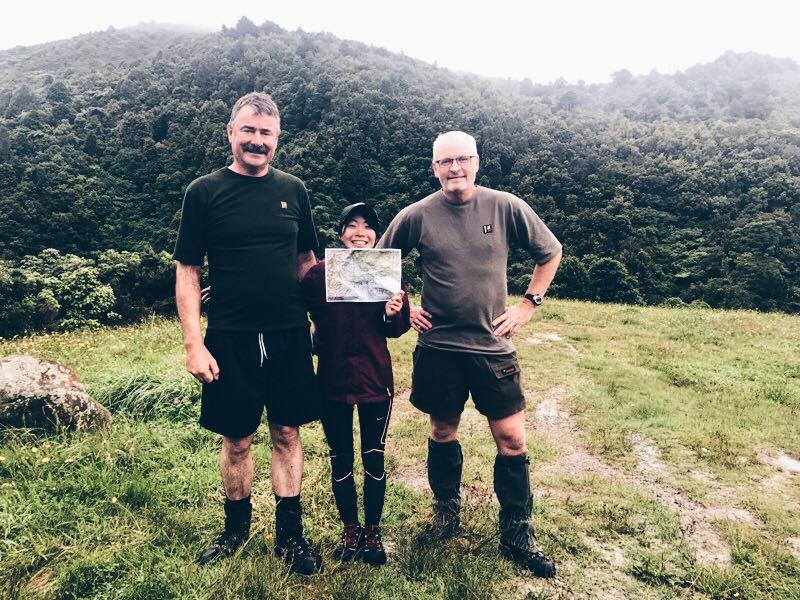
“Creya? Creya?” About four hours after I reached the bank, I heard someone calling outside my tent. I thought the other three people who had gone ahead had caught up. When I crawled out, two tall New Zealanders were standing on the trail. “We heard what happened. We came to help you cross and get out.”
After I disappeared from the American women’s sight, they had activated a Personal Locator Beacon (PLB). Once we were reunited, they cancelled the alert, but that left the search-and-rescue team confused. They decided to send people up anyway to make sure there had been no accident.
This was my third time returning to that stream. Now the water was clear enough to see the bottom, and reached only my calves. The three of us had overlooked the obvious warning sign of muddy water. We also saw with our own eyes how quickly the stream rose and fell: during the half hour we spent debating whether to cross, the water had already risen several dozen centimetres.
We followed the rescuers back to the police station in the nearest town to report what had happened. We thanked the search-and-rescue team deeply and apologised, extremely worried that we might have used the emergency beacon improperly and placed an unnecessary burden on them.
“You did not handle anything incorrectly. You helped one another, stayed calm, pressed the emergency button to ask for help at the first opportunity, and observed the situation while waiting for rescue. You did well. Today’s situation came from one wrong judgement, and everyone makes wrong judgements sometimes.” The three of us cried together. The warmth of the police officers and rescuers helped us let go of some of the fear. It was a lesson I will never forget.
It was all luck. But I had made it back to the trail, safe and sound, and I would keep walking.
📍 Te Araroa Trail | New Zealand’s 3,000-kilometre hiking diary | Back to the complete series index


