


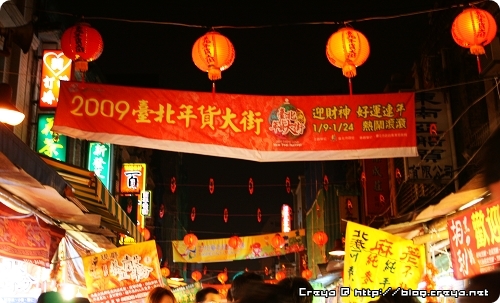
When Taipei locals think of Lunar New Year shopping streets, the first place that comes to mind has to be the biggest one of all—Dihua Street! Even during the rest of the year, Dihua Street is lined with shops selling all kinds of dried goods, candy, biscuits, and traditional Chinese medicine, and it has been that way for ages. I remember my mom taking us there when I was very little, but it had been so long since my last visit that my memories were almost completely gone! I finally got the chance to revisit Taipei’s Dihua Lunar New Year Market. It was as lively as ever, and you could still happily sample food all the way down the street. With better overall planning now, though, the whole place felt much more polished.
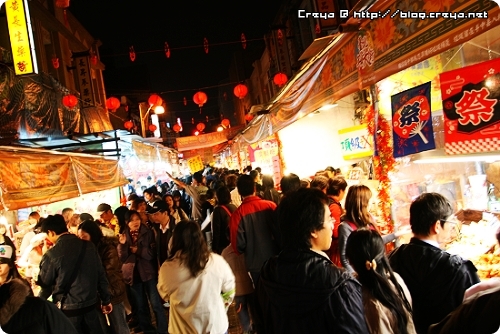
We went on a Monday evening at a little after six, almost seven. I had expected huge crowds, but when we first arrived it wasn’t too bad—sometimes there was hardly anyone within 10 meters in front of or behind us. After eight, however, the crowd suddenly swelled, and we were practically walking pressed up against other people. So if you want to visit, it’s best to go on a weekday and arrive early. If you work regular office hours, rush over as soon as you get off work!
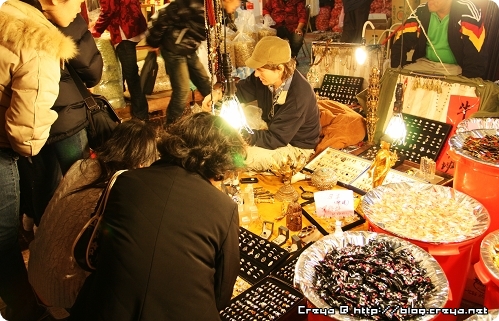
As soon as we reached the bustling entrance to the Lunar New Year Market, we spotted this foreign guy selling accessories. It was certainly a great gimmick. The accessories had absolutely nothing to do with Lunar New Year, but just look! Set up here at a market packed with women, the stall still drew plenty of them over to browse and shop. A foreign face selling accessories in Taiwan also somehow made it seem as though he must have lots of “imported goods.” His Chinese was actually quite good, though, and apparently he had set up shop at the market several times before. Some of the accessories were pretty unusual, but more than NT$600 for one bracelet was far too expensive for me!
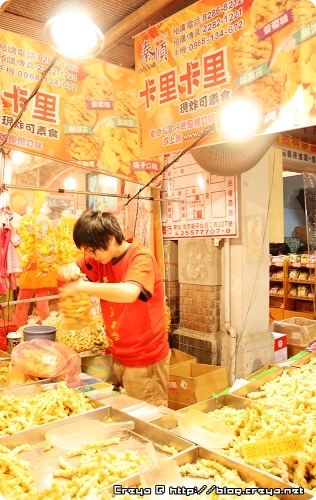
[Purchase No. 1]: Kali Kali
This was the first Lunar New Year treat I bought—Taishun’s Kali Kali! It was a little different from the kind I ate as a child because it came in all sorts of flavors, and it was so delicious! I bought one bag each of sweet seaweed and glucose flavors. Two bags for NT$100 was pretty reasonable. My roommate and my graduation-project teammates all loved them; we nearly finished the entire bag of glucose-flavored Kali Kali during a single meeting!
There were actually several shops selling Kali Kali along the street. After sampling them, we thought Taishun’s tasted the best. Then again, that may very well have been because it was the first one we tried. By the time we sampled Kali Kali from the other shops, we had already eaten squid, drunk soup, and nibbled all sorts of things along the way, so our taste buds had pretty much stopped working. You should sample the different shops yourself and pick your favorite!
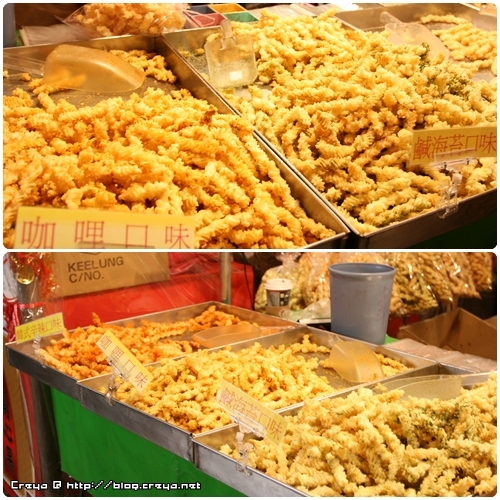
They had lots of flavors, including curry, Korean spicy, savory seaweed, sweet seaweed, glucose, and more. (I’ve forgotten all the ones that weren’t in the photo :p.) The huge piles of golden Kali Kali laid out in front of us looked very tempting.
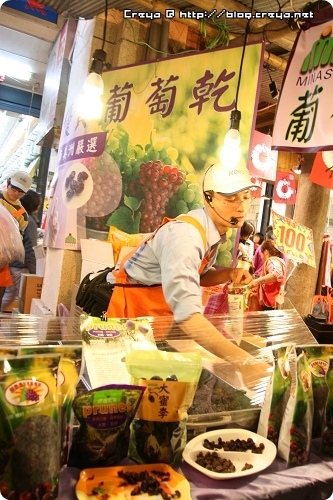
[Purchase No. 2]: Premium Raisins
These raisins also ended up coming home with me, though raisins might not seem particularly special since supermarkets sell them too, including imported Sun-Maid raisins. What made these premium raisins different was their size. They were big enough to feel satisfyingly substantial when you bit into them, and they were sweet and delicious—not like ordinary little raisins that disappear in one bite. A triangular zip-lock bag like the one in the photo cost NT$100. I ended up giving this bag to our hairstylist as a souvenir, and now I really want to buy another one!!!
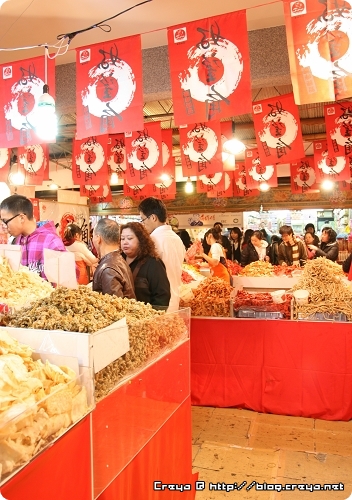
Cape of Good Hope had around three shops along the Lunar New Year Market, specializing in seafood-based dried snacks such as shredded squid, squid chunks, and shredded codfish snacks. There were samples of everything, so we had a wonderful time eating, and the shops were decked out in bright red, making them both eye-catching and photogenic. But none of that was why we went inside (hahaha). It was actually because of their terrifying customer-grabbing sales tactic. How terrifying? The moment you walked past a shop, several guys would step in front of you and block your path, forcing you to walk through the shop. One shop would have been bad enough, but all three Cape of Good Hope locations on the street did the same thing. I had to browse shredded squid three times! It left me feeling rather helpless and annoyed, but I also felt sorry for the part-time workers blocking people. One of them even said, “Please help me out—I’m having such a hard time! Just come in and try a sample.” So…what a terrible boss!
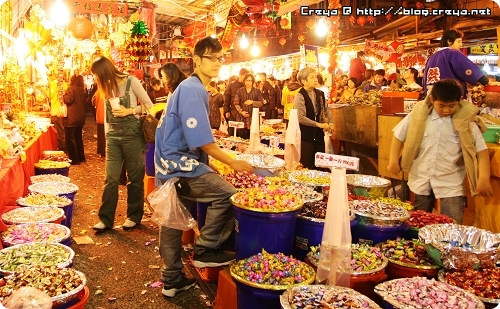
Candy everywhere—it looked especially exciting, hahaha. I wanted to try one of everything.
What makes Dihua Street special is that buying and selling there still follows traditional customs, so it feels more like a wet market. All the food is stacked in tall piles or placed on the ground in huge tubs and bags, then sold by weight, so you can buy exactly as much as you need. Nowadays, most people shop at supermarkets and convenience stores and are used to buying prepackaged goods with fixed prices. But sometimes you don’t want that much of one thing, or you want to try lots of different things in small quantities. At times like those, it’s wonderful to be able to grab a handful and pay by weight.
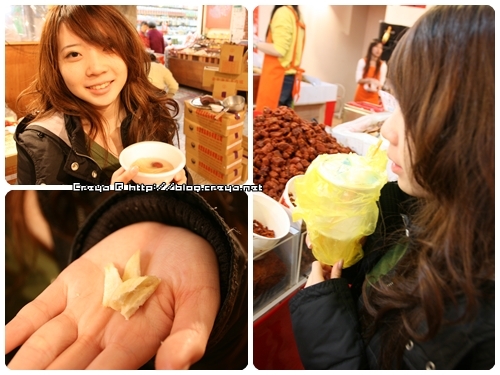
We ate and drank all along the way, trying a nourishing herbal soup (top left) and some terrifying garlic biscuits (bottom left), so bringing a cup of green tea (right) to clear away all those mixed flavors was essential.
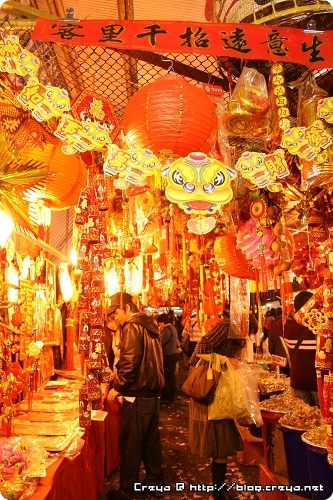
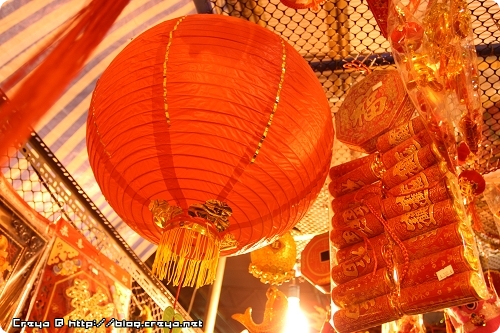
Besides dried goods, the market also sold Lunar New Year decorations, ornaments, and supplies, such as the festive lanterns hanging above, spring couplets, and red envelopes. Displayed together in one big spread, all that red looked beautiful.
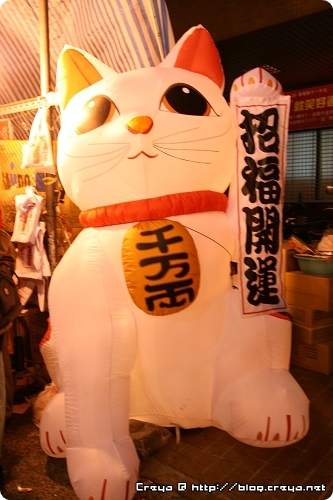
There were also adorable, enormous lucky cats to bring good fortune and luck.
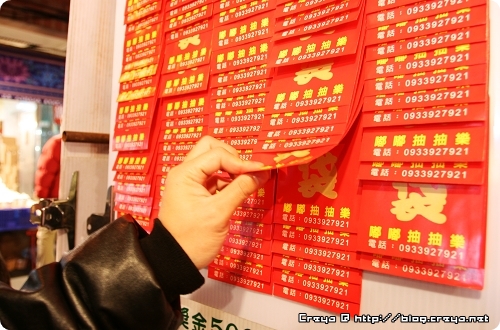
I even played a lucky-draw game that I hadn’t tried in ages. You chose a red envelope containing a number, and only numbers up to 50 won prizes. I picked two envelopes and got nothing both times!
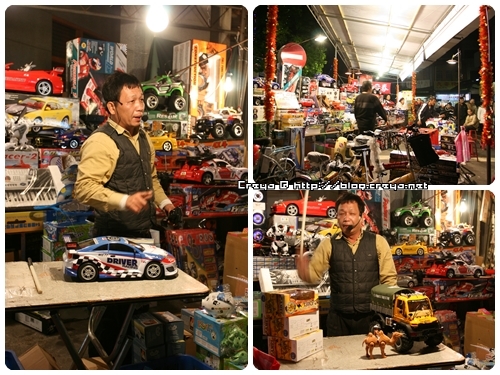
This is another classic feature of Taiwan. At first glance, you might think they were simply selling toys, but it was actually an auction. The host wore a little portable microphone and held up a toy for sale. After rattling off a long, rapid-fire introduction, he invited the crowd to call out bids. Although he claimed you could bid whatever you wanted, he would still give you a hard time if your bid was too low, and if he wasn’t happy with the price or thought it wasn’t enough, he simply wouldn’t sell. But if you joined the bidding and named a price he considered respectable—NT$100 or NT$200 apparently didn’t qualify—he would give you a small toy.
Every host was a gifted talker who could keep up a long monologue all by himself. There were around three of these stalls at the Lunar New Year Market, though they all appeared to be run by the same group and sold roughly the same toys. If you get the chance, you can stop and watch or even join in. (You can always play it safe and simply not buy anything!)
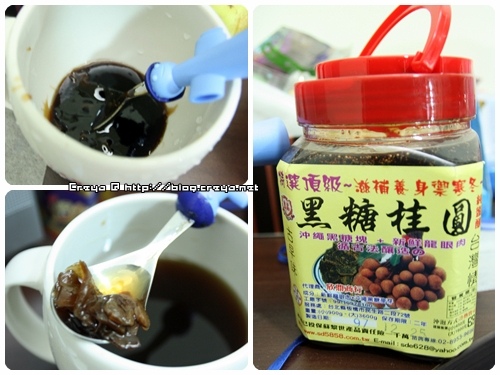
[Purchase No. 3]: Brown Sugar and Longan Concentrate
I originally really wanted to buy some dried longan, which I absolutely love, at the Lunar New Year Market. But then I sampled this “Brown Sugar Longan” concentrate and it was delicious, so I decided to use it to make warm drinks through the winter and nourish my body at the same time. You can dilute it at a ratio of 1:10 or 1:7—just mix it to whatever strength you like. Look, I only had to scoop out a little to make a warming cup of longan tea, and there were still loads and loads of longan pieces in it. At the stall, they also demonstrated adding fresh milk to make longan milk tea, which was delicious too. A small jar filled to the brim—apparently 990 g—cost NT$300. It felt like it would last for ages!
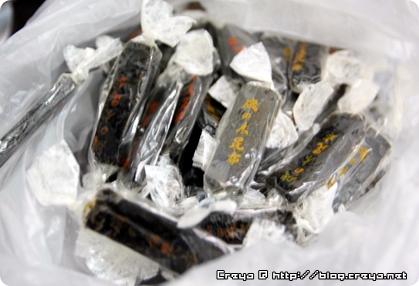
[Purchase No. 4]: Japanese Kombu
I’ve loved this kind of Japanese kombu since I was little. Each piece is made of about three or four layers, with the two outer layers consisting of individual sheets of kombu. I always peel those two sheets off by hand and eat them one at a time. This stuff has always been expensive, though, and still is today—but it’s Lunar New Year, so why not buy a little and treat myself!
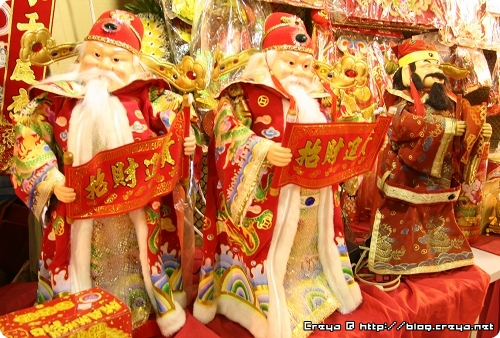
And finally, wishing everyone a Happy Lunar New Year—may wealth and treasure come your way!
 Important Information
|
Event dates: 2009/1/9–1/24 |


